Wooden Crate Sizes: Standard Dimensions, Capacities & Costs
Wooden crate sizes are not one-size-fits-all. Base footprint, wall build, and whether the crate is new or used all move price and weight capacity. This guide lays out the standard wood crate dimensions buyers ask us for most, what they cost new versus used, and how to pick between collapsible, rigid, and open-slat builds.
If you already know your load’s footprint and weight, skip to the size table. If you’re comparing crates to pallets for the first time, jump to section 5.
1. Standard Wood Crate Size Table
Wood crate dimensions are usually quoted as outside dimensions (OD) — length x width x height, measured over the exterior skids and panels. Internal (ID) usable space is smaller, because crate walls are typically built from 3/4 in to 1-1/8 in lumber or plywood, plus 2×4 or 4×4 skids on the base. As a rule of thumb, subtract roughly 1.5–3 in per side for ID versus OD on light-duty crates, and more on heavy-duty builds with thicker cleats.
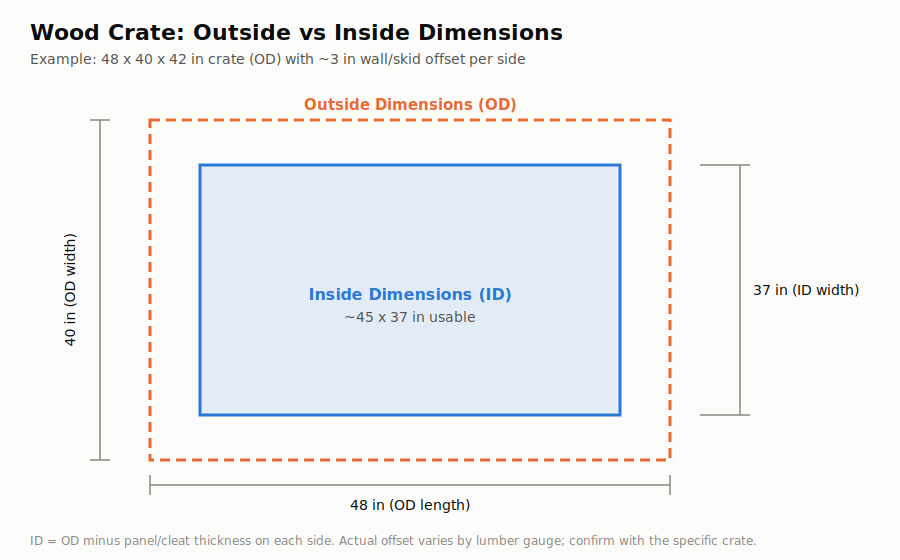
The table below covers the base footprints we see requested most often: the 48×40 pallet-compatible family (matches a standard GMA pallet footprint, so it stacks and fork-handles like one), the 48×48 family used for bulkier or square loads, and smaller/odd-lot footprints such as 43x43x28 and 50.5×38.5×30 that show up frequently in the used-crate market from machinery, appliance, and equipment shipments.
| Outside Dimensions (L x W x H, in) | Approx. Inside Dimensions (in) | Empty Weight | Rated Capacity |
|---|---|---|---|
| 40 x 40 x 40 | ~37 x 37 x 37 | 90–130 lb | commonly 1,500–2,500 lb static load |
| 43 x 43 x 28 | ~40 x 40 x 25 | 80–120 lb | commonly 1,200–2,000 lb, lighter-duty equipment crate |
| 48 x 40 x 24 | ~45 x 37 x 21 | 70–110 lb | commonly 1,000–1,800 lb |
| 48 x 40 x 30 | ~45 x 37 x 27 | 90–130 lb | commonly 1,500–2,200 lb |
| 48 x 40 x 42 | ~45 x 37 x 39 | 110–160 lb | commonly 1,800–2,800 lb |
| 50.5 x 38.5 x 30 | ~47 x 35 x 27 | 100–140 lb | commonly 1,500–2,400 lb |
| 48 x 48 x 24 to 48 | ~45 x 45 x (21–45) | 100–220 lb | commonly 2,000–3,500 lb |
| 84–96 x 48 x 48–54 | ~81–93 x 45 x (45–51) | 250–450 lb | commonly 3,500–6,000+ lb, heavy-duty gauge |
Capacity ranges vary by lumber species, panel thickness, and whether the crate is nailed, screwed, or bolted — always confirm the rated static/dynamic load with the specific crate you’re buying rather than assuming the midpoint of these ranges. These figures are cross-checked against standard SKU listings from multiple industrial crate suppliers rather than a single manufacturer’s spec sheet.
Looking for large wooden crates outside this range? Custom footprints up to and beyond 96 x 48 x 54 are common for machinery, generators, and vehicle components — the pricing logic in section 4 still applies, just scaled up.
2. Collapsible vs Rigid vs Open-Slat Crates
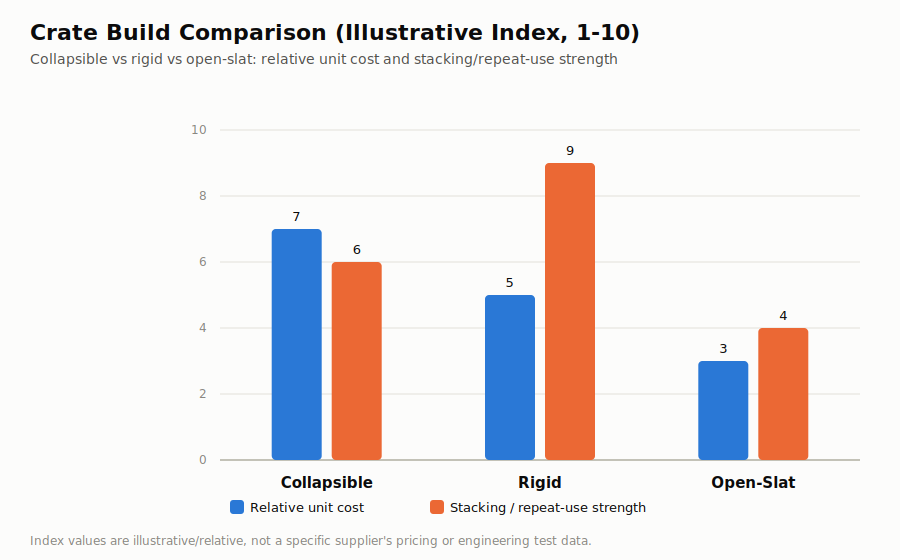
Three build styles cover most wooden shipping crates for sale:
- Collapsible (knock-down) crates. Panels hinge or pin together and fold flat for return shipping or storage — typically 1/4 to 1/3 the stored footprint of the assembled crate. Best for closed-loop shipping lanes where the crate comes back empty. Slightly higher unit cost than rigid, offset by lower return-freight cost.
- Rigid (non-collapsible) crates. Panels are fixed — nailed, screwed, or cleated permanently. Stronger for stacking and repeated heavy loads because there are no hinge points to fatigue. Lower unit cost than collapsible at the same capacity, but takes full cube in storage and return transit.
- Open-slat crates. Walls are spaced boards rather than solid panels. Lighter, cheaper, and better ventilated — common for produce, parts that don’t need dust/moisture protection, and loads inspectors need to see without opening. Lowest capacity and weather protection of the three.
The collapsible vs non-collapsible crates decision usually comes down to whether the crate travels one-way or round-trips. One-way or long-term storage: rigid. Repeated shipments where you’re paying return freight on an empty crate: collapsible.
3. Heat-Treat / ISPM-15 for Export
If a wooden crate is crossing an international border with solid wood packaging material (pallets, skids, dunnage, or crate panels), it almost always needs ISPM-15 certification. This is the question we get most from first-time exporters, so here’s the short version:
- What it is. ISPM-15 is the International Plant Protection Convention standard requiring solid wood packaging to be heat-treated (HT) to a core temperature of 56°C for 30 minutes, or methyl bromide fumigated (MB, now restricted/phased out in many jurisdictions), to kill pests and larvae before it crosses a border.
- The stamp. Compliant wood carries a visible IPPC mark burned or stamped into the wood — the IPPC logo, a two-letter country code, a facility registration number, and the treatment code (HT or MB). This is not optional signage; customs can reject or fumigate non-compliant shipments at the border.
- What’s exempt. Plywood, OSB, particleboard, and other manufactured/reconstituted wood panels are generally exempt from ISPM-15 because the manufacturing process itself kills pests. If your crate is built from manufactured panels rather than solid dimensional lumber, confirm exemption status with your freight forwarder rather than assuming.
- Who to ask. Always confirm current requirements with your destination country’s customs authority or your freight forwarder before shipping — treatment rules and accepted methods (HT vs MB) vary by country and do change.
If you’re buying used crates for export, ask the seller whether the original ISPM-15 stamp is still legible on the wood. A used crate with an intact, verifiable stamp doesn’t need re-treatment; one with the stamp cut off, sanded, or on a replaced panel may need to be re-certified before it ships.
4. New vs Used Wood Crate Cost by Size Band
Wood crate cost scales with footprint, wall thickness, and whether you’re buying new or reclaimed/used. As a planning range:
| Size Band | New Price (each) | Used/Reclaimed Price (each) | Typical Savings |
|---|---|---|---|
| Small (up to 40 x 40 x 40, incl. 43x43x28) | commonly $60–$180 | commonly $35–$110 | ~35–45% |
| Mid (48×40 base, 24–42 in tall, incl. 50.5×38.5×30) | commonly $120–$320 | commonly $70–$200 | ~35–45% |
| Large (48×48 base, 24–48 in tall) | commonly $250–$600 | commonly $150–$380 | ~35–40% |
| Heavy-duty / oversized (84–96 in length, 48+ in tall) | commonly $600–$1,800+ | commonly $350–$1,100 | ~30–40% |
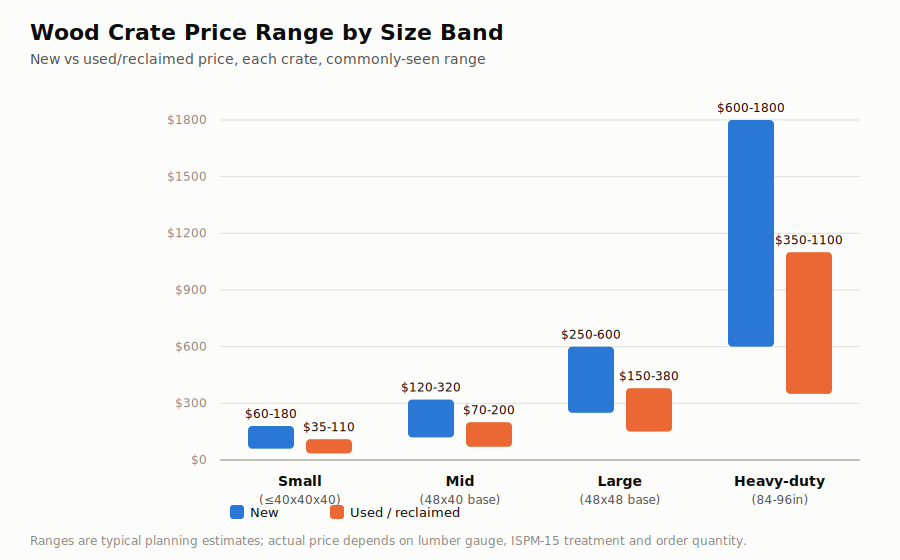
A few things move a given crate up or down within its band: lumber species and gauge, whether it’s collapsible (adds cost) or rigid (lower cost), ISPM-15 heat-treatment (adds cost over non-treated), and single-unit purchase versus pallet-quantity/bulk buys, which typically bring per-unit price down 15–30%. Used crates priced right typically show cosmetic wear — scuffs, prior stencil marks, re-driven fasteners — with no loss of rated capacity if the structural panels and skids are sound. Always ask for the load rating on a used crate rather than assuming it matches new-crate specs for the same footprint.
5. When a Crate Beats a Pallet
Pallets are cheaper and faster to load, but they only work when the load is self-supporting, stretch-wrap-stable, and not fragile. A wooden crate earns its higher cost when any of the following apply:
- The load is irregular, fragile, or top-heavy and needs enclosed panel support on all sides, not just a flat deck.
- The shipment needs weather, dust, or tamper protection in transit or outdoor storage.
- You’re exporting and need a controlled, ISPM-15-stamped enclosure rather than open dunnage.
- The contents need to be lifted, rigged, or stacked in ways that would crush a wrapped pallet load.
- You want a reusable, closed-loop container (collapsible) instead of single-use pallet + stretch wrap + edge protectors every trip.
For a fuller side-by-side on cost, reusability, and load types, see our crate vs. pallet comparison.
6. FAQ
What is the most common wood crate size?
The 48 x 40 in base — matching a standard pallet footprint — is the most requested, typically in 24 in, 30 in, or 42 in heights depending on load height. It fork-handles and stacks like a standard pallet.
How much weight can a wooden crate hold?
It depends on lumber gauge and footprint. Light-duty crates commonly hold 1,000–2,000 lb; mid-size 48×40 and 48×48 crates commonly hold 1,500–3,500 lb; heavy-duty oversized crates are commonly rated 3,500–6,000+ lb. Always confirm the specific crate’s rated static and dynamic load rather than assuming by size alone.
Are inside dimensions or outside dimensions more important?
Inside dimensions (ID) tell you what will physically fit; outside dimensions (OD) tell you what footprint you need for the truck, warehouse rack, or container. Confirm both before ordering — ID is commonly 1.5–3 in smaller than OD per side, more on heavy-duty builds.
Do I need ISPM-15 for domestic shipments?
No. ISPM-15 heat-treatment and stamping is required for solid wood packaging crossing international borders, not for shipments that stay within the same country.
Is a used wood crate as strong as a new one?
Structurally, yes, if the panels and skids show no rot, crushing, or fastener pull-through. Cosmetic wear doesn’t reduce capacity. Ask the seller for the rated load and inspect the corners and base before buying.
Should I buy collapsible or non-collapsible?
Buy collapsible if the crate returns to you empty on a repeat lane — you save on return freight and storage cube. Buy non-collapsible (rigid) if it’s a one-way shipment or long-term storage container, since rigid crates cost less per unit and hold up better under repeated stacking.
Get Your Wooden Crate
Ready to buy or move inventory? Shop used wood crates for sale across the size bands above, new and used, or sell your surplus wooden crates if you’re clearing out inventory. Container Exchanger connects buyers and sellers of wood crates nationwide — get a quote in minutes instead of waiting on a custom crate build.