Table of Contents
You need bulk liquid storage without breaking the bank. So you do a brief internet search, and you find IBC totes for everything from a couple hundred dollars to well over a grand.
But it’s not always clear what you’re actually getting for the price difference. New IBCs, used tanks, reconditioned totes, rebottled containers, the options pile up fast, and you know that the wrong choice can cost far more than you saved. So, how do you get the right one for your needs?
This guide explains each condition type, when to use them, and their cost. It will give you a clear framework for making the right call based on what you’re actually storing.
What Are Intermediate Bulk Container (IBC) Tanks and Totes?
Intermediate bulk container (IBC) tanks, totes, and containers are large, reusable containers designed for storing and transporting liquids in industrial quantities. The standard design is a high-density polyethylene (HDPE) inner bottle nested inside a galvanized steel cage, mounted on a pallet base that works with pallet jacks and forklifts.
They show up across chemical manufacturing, food processing, agriculture, and construction. The HDPE material resists a wide range of chemicals and can include UV inhibitors that extend outdoor service life. The cage provides structural integrity during stacking and transport, and the bottom valve makes dispensing straightforward without pumps or tipping.
The Four IBC Tote Conditions: New, Reconditioned, Rebottled (Recycled With New Bottles), and Unrinsed
When you’re shopping for IBC containers online, you’ll notice there are four possible conditions.
- New: Factory-fresh with no prior use. The HDPE bottle, cage, valves, and pallet are all original and uncontaminated. These come with full manufacturer certifications and are the only option for certain regulated applications.
- Reconditioned: Reconditioned IBC totes are previously used containers that are easily cleaned, inspected, and refurbished to restore them to working condition. The original inner bottle is retained.
- Rebottled: Rebottled IBC totes feature a new bottle, specifically a food-grade HDPE inner liner, set inside an outer metal cage that can be reused multiple times.
- Unrinsed: These are non-reconditioned industrial containers that have had no cleaning performed after their previous use. Unrinsed totes are only appropriate for storing waste materials or non-consumable construction liquids.

Common IBC Tote Sizes: 275-Gallon vs 330-Gallon
The two most frequently purchased sizes are the 275-gallon tote, which holds about 1,040 liters, and the 330-gallon tote, which holds about 1,250 liters.
Used 275-gallon tanks are more widely available on the used market. The 330-gallon has gained traction in use cases where maximizing volume per pallet footprint is important. Both sizes have the same standard pallet footprint and move through facilities on the same equipment.
New vs Used IBC Totes: Side-by-Side Comparison
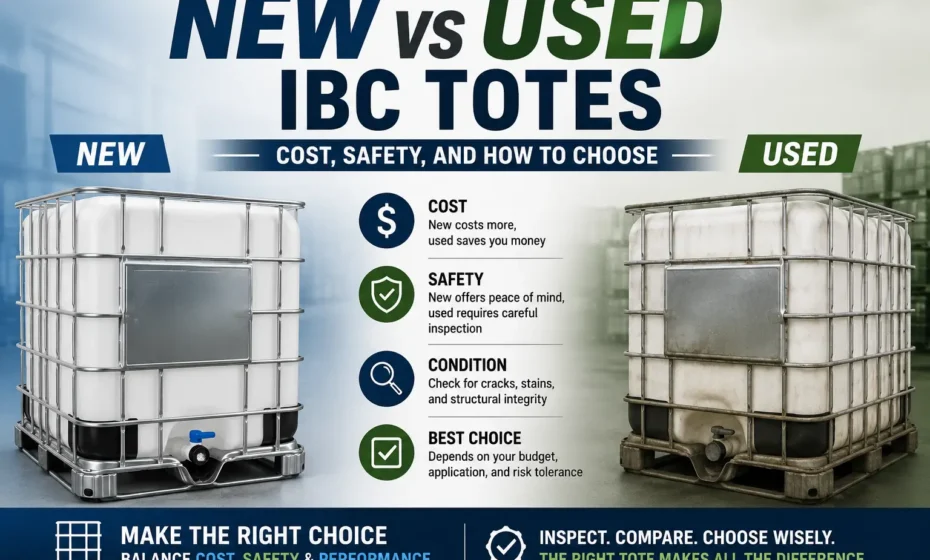
The difference between new and used totes goes beyond price. Here is a direct look at several factors that matter most to buyers.
| Factor | New | Reconditioned / Rebottled | Unrinsed |
| Food-grade suitable | Yes (if certified) | Rebottled only | No |
| UN/DOT certified | Yes | Reconditioned may qualify | No |
| Structural condition | Flawless | Inspected/repaired | Unknown |
| Best for | Hazardous, food products, pharma | Industrial, agriculture | Waste, construction |
How Much Do Used IBC Totes Save?
Used IBC tote price runs 30-60% lower than new IBCs. On a single unit, that may translate to $150 to $300 in cost savings. Across a fleet of 50 or 100 totes, those numbers add up quickly, from around $7,500 up to $30,000… or more.
When You Must Buy New: Food-Grade, Hazardous Materials, and Compliance
All IBCs used to ship dangerous goods must have a UN/DOT certification that’s still valid. To keep that designation, they have to continually pass periodic leak-tightness tests and structural inspections.
Once its certification has expired, a used IBC tote can’t perform functions related to dangerous goods. If your application requires FDA, NSF, or HACCP certification, or if the customer requires a documented chain of custody and zero prior use, new totes would be necessary.
Non-Food vs Food-Grade IBC Containers: Why the Difference Matters
Food-grade IBC totes are made from FDA-compliant virgin HDPE, and the sidewalls are molded with permanent UN/DOT certifications confirming they’re safe for storing food, food ingredients, and potable water. Although non-food-grade totes may look the same on the outside, they are often made from materials not approved for food contact. That means no clean-looking tote without those markings should be considered food-grade.
When Used IBC Totes Are the Smart Choice
Used IBC totes make strong financial sense across a wide range of industrial and agricultural applications. If your operation doesn’t involve food, pharmaceuticals, or hazardous materials requiring active UN certification, a quality reconditioned or rebottled tote will do the job at a fraction of the cost.
Example applications include: storage of non-potable water for irrigation or greywater harvesting; agricultural inputs (fertilizers); industrial lubricants and cleaning agents; and waste materials collection and containment. The trick is to make the tote match your application in license, condition, and use history.
How to Inspect a Used IBC Tote Before Buying
Since most buyers today buy used IBC totes online, it’s impossible to physically inspect them before making a purchase. This makes documentation and seller transparency paramount.
If they’re not part of the listing, request pictures of all four sides of the cage, the bottom valve, the pallet base, and the top fill opening. Ask what the tote previously held to assess chemical compatibility with your intended use. Verify cleanliness: the press wash, steam wash, and rinse have different meanings in residual contamination.
Look for any dents or rust on the cage, or tawny or brown colorations on the HDPE bottle. Light cosmetic cage wear is common; however, structural deformation around the bosses is a no-go. Check that the serial markings on the bottle and cage match, since mismatched components may indicate field assembly from spare parts. Check the bottom valve carefully. A cracked or worn valve is a notable failure point that aggravates your total cost.
Most of this information will be given to you up front by a trustworthy seller. If you’re getting pushback even on the most basic questions, that’s your answer.
Where Most Purchasers Go Wrong With Used IBC Totes
The biggest mistake is treating the purchase price as the entire cost. If a used tote fails on its second fill, the fact that you bought it for $90 is moot. The costs add up in spilled product, cleanup, a potential compliance penalty, and having to buy yet another IBC tote.
Mistake number two is believing that “washed” equals food-safe. Cleaning does remove visible residue; however, due to HDPE’s chemistry, permeation from prior use remains a real issue. Starting with a new or recertified tote that’s never been in contact with a non-food substance is the only way to ensure compliance with food safety standards.
Why Buy IBC Totes from a Certified Reseller Like Container Exchanger
Container Exchanger is a dedicated buy-and-sell marketplace for new vs used IBC totes and a full range of reusable industrial packaging across North America, covering pallet containers, bulk containers, metal storage bins, wire baskets, plastic pallets, carts, and Gaylord boxes.
Let’s say a Midwest food manufacturer needs to shift part of its IBC fleet from food-grade to industrial use as its product mix changes. Rather than retiring the food-grade totes at a loss, they list them on Container Exchanger, recouping a significant portion of their original investment, and source reconditioned totes for their new application at well below new pricing. One purchase funds the other.
Sellers will get top returns on IBC containers that still have useful life. Buyers get quality used inventory at real savings over new. Browse current listings at Container Exchanger to find the right tote for your application and budget.
FAQs
Used IBC totes aren’t safe for drinking water storage unless the tote was originally certified for potable water use, has only ever held food-grade or water-grade substances, and has been properly cleaned and inspected. The tote must carry NSF 61 certification or equivalent to be considered safe for potable water contact.
Used IBC totes can be suitable for food-grade purposes only in the form of rebottled totes, which feature a new food-grade HDPE inner bottle inside a reused cage. The distinction between reconditioned vs rebottled IBC totes is the most critical thing to understand for food-safety decisions. A standard reconditioned tote retaining the original bottle isn’t food-safe regardless of cleaning, because previous contents may have absorbed into the HDPE walls.
IBC totes can last anywhere from 5 to 20 years. It all depends on usage, storage conditions, and maintenance. New totes come with manufacturer warranties and typically have the longest operational lifespan. Quality Grade A reconditioned units that have been lightly used can still deliver many years of reliable service. The galvanized steel cage often outlasts the HDPE bottle, which is exactly why the rebottled format makes strong economic sense for long-running operations.