Table of Contents
Every shipment starts with a decision most people underestimate: how do you contain and protect what you’re moving? The wrong packaging decision costs money, damages the product, and slows operations down. When it comes to the crate vs pallet debate, there is no universal answer. The right choice depends on factors like your shipping needs, transportation methods, how far the products or boxes have to go, how secure they need to be, and what your operation looks like on the floor.
Understanding your options and knowing the differences between pallets, pallet skids, and crates gives you the clarity to make that call with confidence.
What Is a Pallet or Pallet Skid?
Pallets and pallet skids are two distinct products that often get used interchangeably in conversation but serve different purposes in practice.
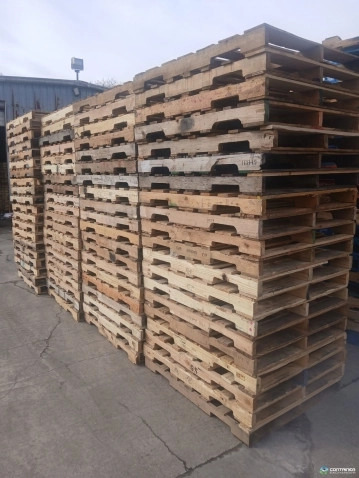
A pallet is a flat, two-sided platform with both a top deck and a bottom deck connected by stringers or blocks. That bottom deck helps with even weight distribution, adds stability when stacking, and increases resistance to tipping in racking systems. Standard pallets run 48 x 40 inches and are built to move with a forklift or pallet jack.
A pallet skid has a top deck and support stringers but no bottom deck. That open underside sits lower to the ground and makes it easier to drag a skid into position (due to less friction). Skids are a better fit for heavy, stationary equipment that needs a stable base rather than one that moves repeatedly through a distribution system.
Pallets come in wood, plastic, and metal. Wood pallets are the most widely used due to availability and low cost. Plastic pallets are lighter weight, moisture-resistant, and sanitary, making them a strong choice for food and pharmaceutical environments. Steel pallets handle heavy loads. Industries that rely heavily on pallets include retail distribution, food and beverage, automotive, and manufacturing.
What Is a Crate?
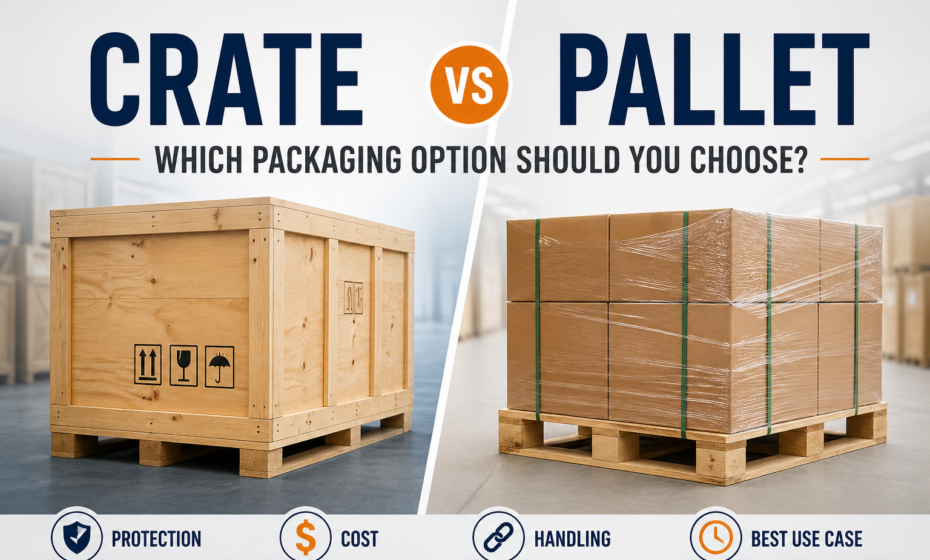
A shipping crate is a fully enclosed container with four walls that surrounds its contents. Where a pallet provides an open platform for goods to sit on top of, a crate wraps around the load entirely, shielding it from impact, moisture, dust, and theft.
Crates are built with superior protection as the primary goal. The enclosed structure prevents palletized freight from exposure to the elements and minimizes movement. Crates can be locked or sealed to add security for high-value cargo, and custom crates can be built to fit the exact dimensions of a product.
Wooden crates are typically the most common, valued for structural strength and customizability. Wood can be engineered with internal blocking, foam inserts, and bracing to match specific requirements. Steel crates offer unmatched durability for extreme conditions or long-term storage. Industries that favor crates include aerospace, medical device manufacturing, fine art logistics, and electronics.
Crate vs Pallet: Major Differences
The most fundamental difference between crates and pallets is structural. A pallet is an open platform, while a crate is a closed container. That single distinction drives nearly every other difference between the two.
Pallets are optimized for speed and output. They’re standardized, forklift-compatible, and built to flow through automated systems and racking environments. According to data cited by Palletone, 95% of packaged products in the U.S. are shipped on pallets, which tells you everything you need to know about how central they’re to modern logistics.
Crates trade speed for protection. They’re heavier and often custom-built, requiring more efficient handling time. But for the safety of fragile goods or high-value freight, that tradeoff pays off in the long haul. Pallets win on upfront cost. Crates carry a higher initial price due to the use of more materials and fabrication, though both can last five to ten years with proper care and can be recycled at the end of life.
One area most competing blogs skip entirely is the crate-on-pallet hybrid efficiency option. A pallet is fastened to the underside of a crate, creating a hybrid of pallets and crates that delivers the full enclosure of a crate with the forklift mobility of a pallet.
For products that need maximum protection in transport but also need to flow through a warehouse efficiently on arrival, this approach gives operations teams both without sacrificing either.
| Feature | Pallet | Pallet Skid | Crate |
| Structure | Open platform, top and bottom decks | Top deck only, no bottom deck | Fully enclosed container |
| Mobility | Forklift/pallet jack compatible | Dragged into place | Often requires manual material handling; can be combined with pallet for forklift use |
| Protection | Minimal – exposed sides | Minimal – exposed sides | High – shields from impact, moisture, dust, theft |
| Ideal for | Stackable, durable goods | Heavy, stationary equipment | Fragile, high-value, sensitive items |
| Common Industries | Retail, food & beverage, automotive, manufacturing | Industrial heavy machinery, equipment | Aerospace, electronics, medical devices, fine art logistics |
Choosing the Best Option for Your Needs
Industry-specific uses often determine the choice between crates and pallets, with retail relying on pallets and sectors like pharmaceuticals using crates for fragile items. However, businesses should consider the following factors as well before deciding.
Consider Product Type, Especially if Shipping Fragile Items
For durable, stackable goods that tolerate some exposure during transit, pallets are the practical choice. For fragile, high-value, or sensitive items, crates provide a level of protection that an open platform cannot match. Electronics, medical equipment, and precision instruments all benefit from full enclosure on all sides.
Shipping Distance: Domestic or International Shipping?
Shorter domestic routes with controlled handling tend to favor pallets. International shipments introduce far more variables: rough handling at ports, extended transit times, and humidity changes. Using crates for international shipments offers a safe and flexible option for shipping fragile items, accommodating both standard and non-standard freight dimensions.
International shippers using wooden crates or wood pallets need to account for ISPM 15 compliance. According to the USDA Animal and Plant Health Inspection Service (APHIS), updated December 2025, “all wood packaging material used to carry cargo into or out of the United States must be treated and certified per International Standards for Phytosanitary Measures No. 15.”
Budget: Upfront Cost vs Long-Term Value
Wood pallets remain the cheaper version for most operations. They’re widely available and easy to source across North America. For businesses moving large volumes of standard freight, their economics are hard to beat. Crates require a larger upfront investment, but for high-value freight, that investment often pays for itself through avoided damage and claims.
The Cost-Effective Supply Chain Choice: Pallet, Pallet Skid, or Crate?
Pallets and pallet skids move freight efficiently at scale. Crates protect freight that cannot afford to arrive damaged. In many operations, the smartest decision is understanding where each earns its place rather than defaulting to one. Before committing to a packaging or shipping method, evaluate the full picture: what you’re shipping, how far and often it ships, and what a damaged shipment actually costs.
Container Exchanger connects buyers and sellers of pallets, crates, bulk containers, returnable totes, industrial bins, nesting totes that take up less space, plus reusable packaging across North America. Browse our available inventory today.