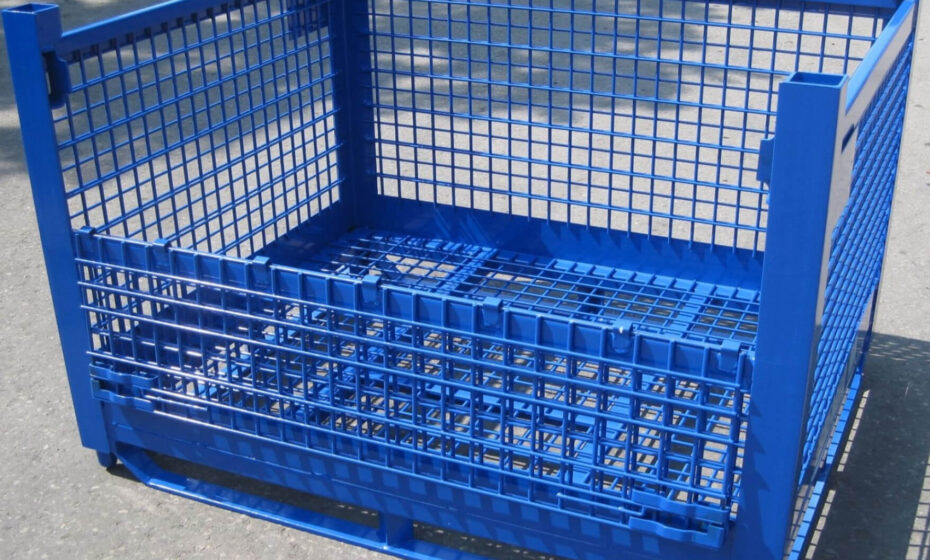
Ordering wire containers without checking the spec sheet is how you end up with baskets that don’t fit your racking, won’t nest with your existing fleet, or buckle under loads they were never rated for. The good news: wire mesh containers are one of the most standardized products in reusable packaging. Learn the three or four common footprints and the rest falls into place.
What Is a Wire Mesh Container?
A wire mesh container — also called a wire basket, wire bin, or collapsible wire container — is a heavy-gauge steel storage container built from welded wire mesh panels on a rigid base. Most sit on runners or feet sized for forklift and pallet jack entry, and most collapsible models fold flat when empty. They’re the workhorse container for automotive parts, castings, stampings, hardware, and any product that needs airflow, visibility, and drainage that solid-wall containers can’t provide.
Because the walls are open mesh, you can see inventory at a glance and water or washdown fluids drain straight through — which is why you’ll find them everywhere from machine shops to plating lines.
Standard Wire Mesh Container Dimensions
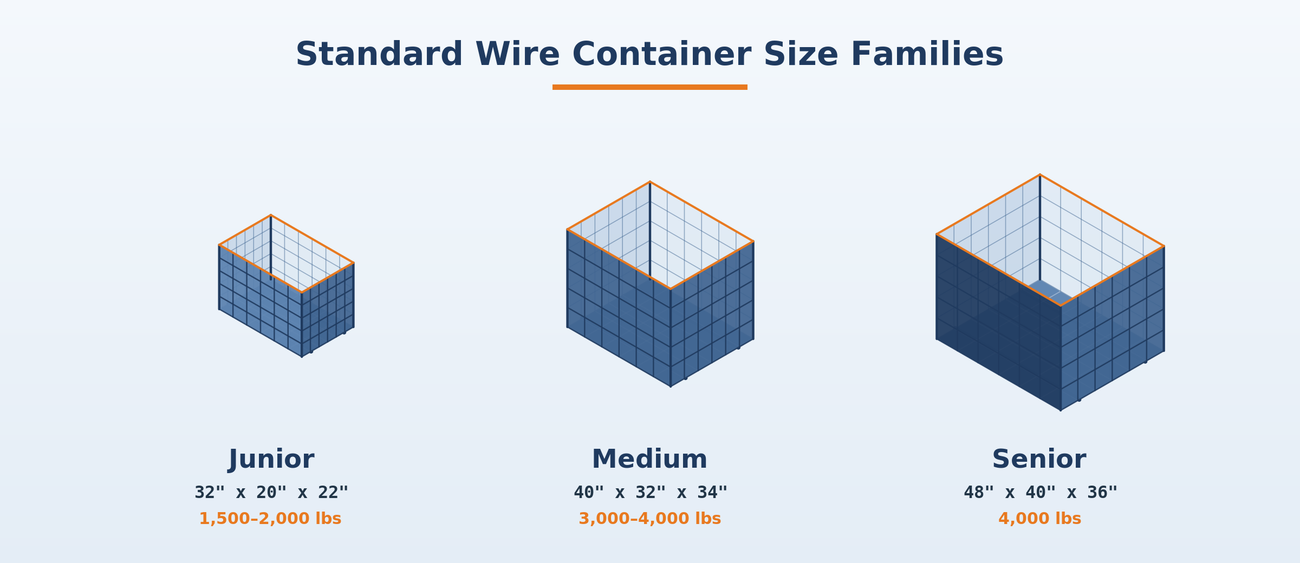
Most wire containers in North America come in three size families, often called junior, medium, and senior:
| Size Class | Footprint (L x W) | Typical Height | Typical Capacity |
|---|---|---|---|
| Junior | 32″ x 20″ | 22″–23″ | 1,500–2,000 lbs |
| Medium | 40″ x 32″ | 34″ | 3,000–4,000 lbs |
| Senior | 48″ x 40″ | 36″–42″ overall | 4,000 lbs |
| GM-style rigid | 54″ x 44″ | 40″ | 4,000+ lbs |
A few notes plant managers will care about:
- The 48″ x 40″ senior matches the standard GMA pallet footprint, so it drops into existing pallet rack positions and trailer load plans without rework.
- Overall height and usable (clear) height are different numbers. A “48x40x42″ basket often has 36” of clear interior height once you account for the base. Check both before you plan cube utilization.
- Automotive OEM baskets (GM-style, often 54x44x40) run larger than the standard families and are usually rigid, not collapsible.
How Much Weight Can a Wire Container Hold?
Capacity depends on size, wire gauge, and whether the basket is collapsible or rigid:
| Container Type | Typical Rated Capacity |
|---|---|
| Junior collapsible | 1,500–2,000 lbs |
| Medium/senior collapsible | 3,000–4,000 lbs |
| Rigid wire baskets | 4,000–6,000 lbs |
First, the rating is per basket, not per stack — a 4,000 lb basket stacked four high means the bottom unit is carrying its own load plus three loaded baskets above it, which is exactly what the corner posts are engineered for, but only when loads are evenly distributed. Second, point loads are the enemy: a single casting concentrated in the center of the mesh floor stresses it far more than the same weight spread across the deck.
Collapsible vs Rigid Wire Baskets
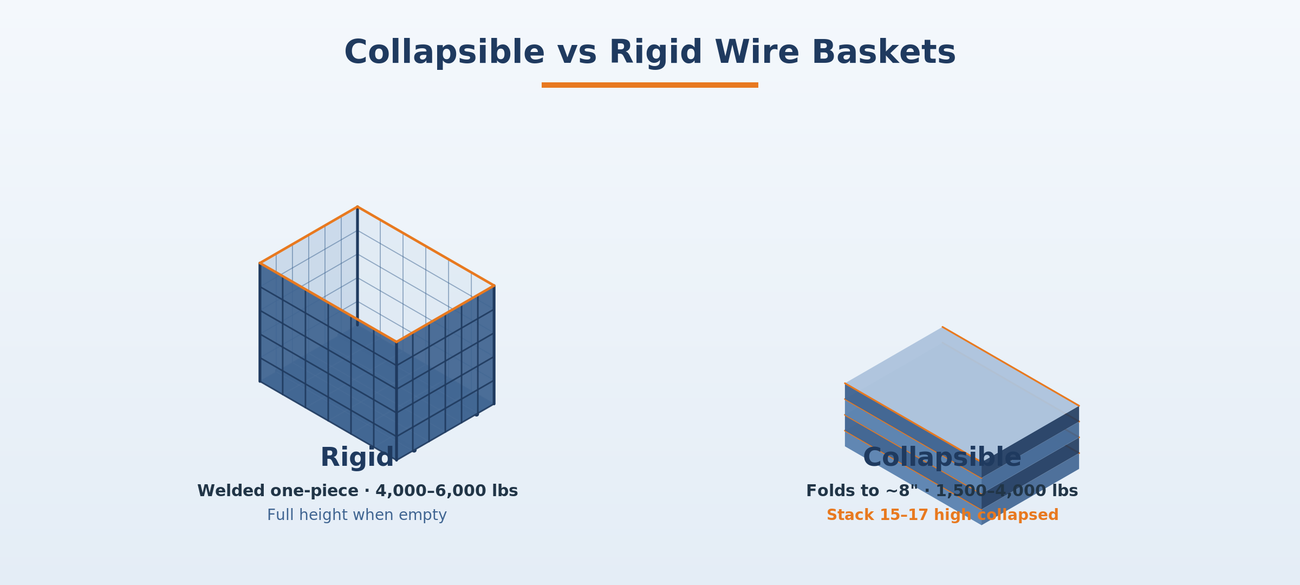
Collapsible wire containers have hinged walls that fold down when the basket is empty. Most include one or two drop gates — half-height doors that fold down so a picker can reach the bottom of the basket without diving in headfirst. Choose collapsible when you ship product one direction and return empties, or when seasonal volume means baskets sit idle part of the year.
Rigid wire baskets are welded as one piece. No hinges means fewer wear points and higher weight ratings — this is why OEM automotive programs favor them. Choose rigid when baskets stay loaded most of their life, when loads run heavy, or when you’re storing in multi-high stacks long-term.
| Factor | Collapsible | Rigid |
|---|---|---|
| Empty storage | Folds to ~8″ high | Full height always |
| Weight capacity | 1,500–4,000 lbs | 4,000–6,000 lbs |
| Access | Drop gate standard | Open top (some with gates) |
| Durability | Very good; hinges are the wear item | Excellent |
| Return freight cost | Low (dense collapsed stacks) | Higher |
Collapsed Height and Stacking: The Space Math
This is where collapsible baskets earn their keep. A typical collapsible container folds to roughly 8″ tall. In practice that means:
- Loaded: stack 3–4 high, depending on rating and load stability
- Collapsed: stack 15–17 high in the same footprint
Run the numbers on a truckload of empties and the case makes itself: collapsed baskets return at four to five times the density of rigid ones. If you’re paying for return freight in a closed-loop system, collapsibility usually pays for itself within the first year.
Mesh Size and Wire Gauge Explained
Mesh is described as opening size by wire gauge — for example, 2″ x 2″ x 6 ga. Smaller openings hold smaller parts; heavier gauge (lower number) carries more weight.
| Mesh Spec | Typical Use |
|---|---|
| 1/2″ x 1/2″, ~11 ga | Small hardware, fasteners, machined parts |
| 1″ x 1″ | Mid-size parts, plated components |
| 2″ x 2″, 2–6 ga | Castings, stampings, general bulk storage |
Most wire containers are galvanized after welding, which seals the weld points against corrosion — a detail that matters if baskets live outside or go through washdown. Powder-coated baskets look sharper but show wear faster in abrasive service.
How to Measure a Wire Container (Inside vs Outside Dimensions)
Sellers list wire baskets both ways, and the difference will bite you:
- Outside dimensions — overall footprint including runners and posts. This is what matters for racking, trailer loading, and floor space planning.
- Inside (usable) dimensions — the actual cargo space. This is what matters for part fit and cube utilization.
- Clear height — interior height from deck to top rail. On a basket listed at 42″ overall, clear height might be 36″.
When comparing listings, confirm which number you’re looking at before you buy. A “48×40” outside basket will not hold a 48×40 dunnage tray.
How to Choose the Right Size
Work through these in order:
- Match the footprint to your pallet standard. If your plant runs 48×40 GMA, buy 48×40 baskets and everything downstream (rack, trailers, conveyors) just works.
- Size height to your rack openings. Measure beam-to-beam clearance and leave 4″–6″ of lift-off room.
- Rate for your heaviest SKU, not your average. Capacity downgrades aren’t a thing; buy the rating you’ll actually need.
- Decide collapsible vs rigid based on the return trip. Empties coming back? Collapsible. Baskets living loaded in the plant? Rigid.
- Count your drop gates. Floor-stacked pick locations want gates; rack-stored baskets don’t need them.
Frequently Asked Questions
What are standard wire basket sizes?
The three common families are 32x20x22 (junior), 40x32x34 (medium), and 48x40x36 (senior). Automotive-style rigid baskets often run 54x44x40.
How much weight can a wire mesh container hold?
Collapsible models typically carry 1,500–4,000 lbs depending on size; rigid welded baskets run 4,000–6,000 lbs. Always check the manufacturer’s tag on the specific unit.
How high can you stack wire containers?
Loaded, most are rated to stack 3–4 high. Collapsed, collapsible models stack 15–17 high for storage or return freight.
Are used wire baskets worth buying?
Usually, yes. Steel wire containers routinely last 10+ years in service, and used units typically sell at a steep discount to new with most of their service life left. Inspect hinges and drop-gate latches — those are the wear points.
Do wire containers work in pallet racking?
Yes — 48×40 footprint baskets drop into standard pallet rack positions. Confirm your beam capacity covers the loaded basket weight.
Shop Wire Baskets at Container Exchanger
Container Exchanger stocks new and used wire baskets and wire mesh containers in standard and OEM sizes across the country, alongside our full range of bulk containers and industrial rack systems. Buying used cuts cost per trip; and when your fleet needs change, we’ll help you sell your surplus baskets too. Browse current inventory or call +1-(404)-551-5599 for a quote.