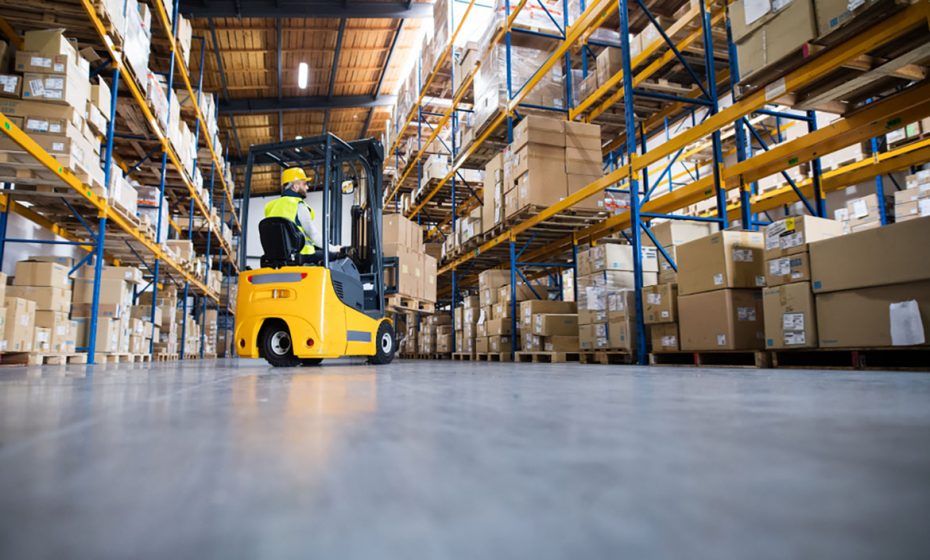
Every warehouse eventually runs out of floor before it runs out of ceiling. Stack racks are the fastest way to fix that without bolting anything to the slab — but only if the capacity math is right. Here are the real numbers on what portable stack racks hold, the standard sizes you’ll find on the market, and how to spec them so the bottom rack in the stack isn’t the one that lets you down.
What Is a Stack Rack?
A stack rack (also called a portable stacking rack, stackable pallet rack, or tier rack) is a freestanding steel frame — typically a pallet-style base with four corner posts — engineered so loaded racks stack directly on top of each other. No anchors, no permits, no fixed footprint. A forklift moves the entire loaded rack, and when demand drops, most models knock down or nest for storage.
That combination — vertical storage that moves — is why stack racks show up wherever inventory is seasonal, product is odd-shaped, or the building layout changes faster than a bolted rack system can.
Stack Rack Weight Capacity: The Numbers
Typical portable stack racks are rated between 1,000 and 4,000 lbs per rack, with 4,000 lbs being the common heavy-duty standard. Stacked 5 high, that’s up to 20,000 lbs riding in a single tier footprint — and the bottom rack’s posts are carrying everything above them.
| Duty Class | Capacity per Rack | Typical Stacking |
|---|---|---|
| Light duty | 1,000–2,000 lbs | 3–4 high |
| Standard | 2,000–3,000 lbs | 4 high |
| Heavy duty | 4,000 lbs | 4–5 high |
Three things determine whether you get the rated capacity in practice:
- Load distribution. Ratings assume evenly distributed loads. A concentrated point load in the deck center effectively derates the rack.
- Stacking alignment. Capacity assumes posts seat squarely in the cups or channels of the rack below. A twisted stack transfers load through the wrong geometry.
- Condition. On used racks, bent posts and cracked welds are the capacity killers. More on inspection below.
Standard Stack Rack Sizes and Dimensions
Stack racks follow common base footprints, usually with 60″–69″ post heights:
| Base (D x W) | Common Post Heights | Notes |
|---|---|---|
| 48″ x 48″ | 60″, 69″ | Compact, general purpose |
| 48″ x 60″ | 60″, 69″ | Most common all-around size |
| 48″ x 72″ | 69″ | Long parts, bundled stock |
| 48″ x 96″ | 69″ | Extrusions, trim, lumber |
| 48″ x 120″ | 69″ | Long bar stock, pipe |
| 60″ x 60″ / 72″ x 72″ | 60″–72″ | Oversized and irregular loads |
Sizing tips from the plant floor:
- Post height sets your cargo ceiling. A 69″ post gives roughly 60″ of clear load height once you account for the base — measure your tallest palletized load plus lift-off clearance.
- Match base depth to your product, not your pallet. Unlike wire baskets, stack racks often carry unpalletized or odd-shaped product; the 48″ x 96″+ sizes exist precisely for loads a pallet can’t handle.
- Check nested/knocked-down height if off-season storage matters. Removable-post models store in a fraction of their assembled cube.
How High Can You Stack? (And What the Bottom Rack Carries)

Most manufacturers rate stack racks for 4–5 high loaded. Before you plan on five, verify three limits:
- Bottom rack capacity. Five racks at 4,000 lbs means the bottom unit supports ~16,000 lbs through its posts plus its own load. Heavy-duty racks are engineered for this; light-duty racks are not — this is the spec that matters most.
- Building clearance. Five 69″ racks is nearly 29 feet of stack. Sprinkler clearance rules (commonly 18″ minimum below heads) and your forklift’s maximum fork height usually cap stacks before the rack rating does.
- Load stability. Top-heavy or shifting loads argue for shorter stacks regardless of what the steel can carry.
Stack Racks vs Pallet Racks: When Portable Wins
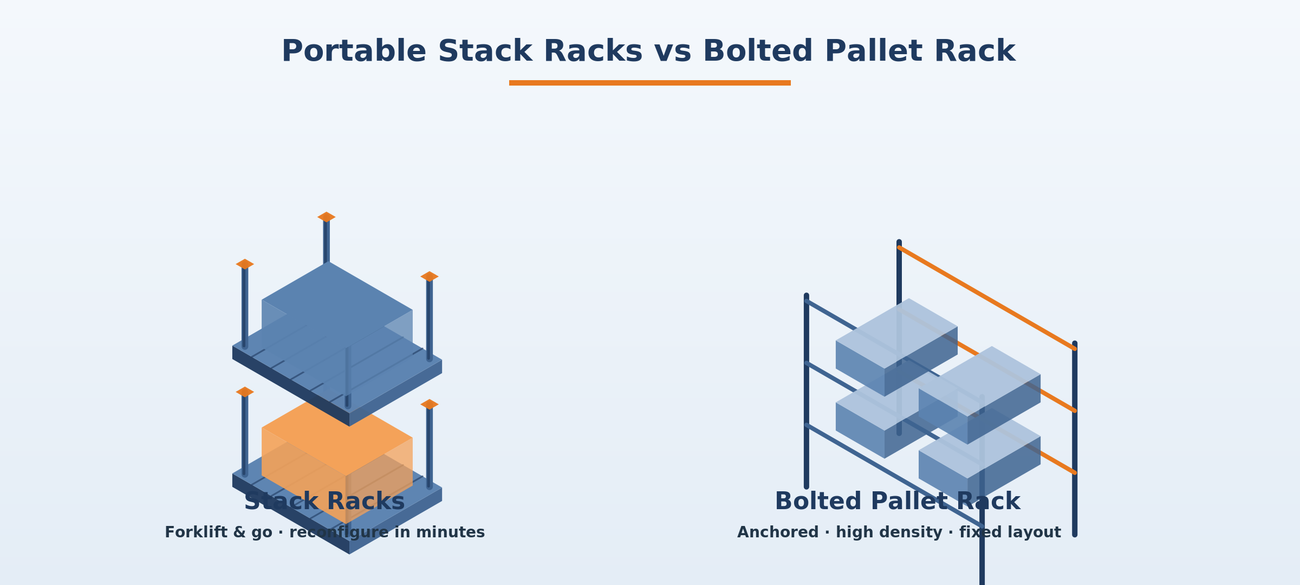
| Factor | Stack Racks | Bolted Pallet Rack |
|---|---|---|
| Installation | None — forklift and go | Anchored, often permitted |
| Reconfiguration | Minutes | Days, plus labor |
| Seasonal storage | Knock down and store | Fixed footprint year-round |
| Cost structure | Per rack, scales with need | Per bay, plus install |
| Best for | Variable inventory, odd loads, leased space | Stable SKUs, high density, fixed layout |
The honest answer: mature, stable SKU profiles in a building you own favor bolted pallet rack systems. Variable demand, short leases, or product that changes shape every season favor stack racks. Plenty of operations run both — fixed rack for the base load, stack racks for the overflow.
Types of Stack Racks
- Removable-post racks. Posts lift out and store on the base — the most compact knock-down option and the most common used-market find.
- Fixed-post (welded) racks. Nothing to lose or reassemble; slightly higher capacity for the same steel.
- Nestable stack racks. Empty racks nest into each other without disassembly — fastest turnaround in closed loops.
- Stackable frames over pallets. Convert a standard pallet load into a stackable unit; useful for crush-sensitive product like bagged goods or soft packaging.
Loading and Safety Best Practices
- Center loads on the base; keep weight inside the post footprint.
- Never exceed the lowest-rated rack in the stack — the stack is only as strong as its weakest unit.
- Seat posts fully in the mating cups before releasing the load.
- Keep heaviest racks at the bottom of the stack.
- Inspect posts, cups, and welds quarterly; pull bent-post units from service immediately.
- Confirm forklift capacity at height — a 4,000 lb rack at 20 feet is a different lift than at floor level.
Buying New vs Used Stack Racks
Stack racks are heavy-gauge welded steel with no moving parts, which makes them one of the safest used-equipment buys in material handling. Used racks commonly sell at 40–60% below new pricing with most of their service life intact. When inspecting used racks, check for bent or out-of-plumb posts, cracked or repaired welds at the post bases, and deformed stacking cups — those three items tell you nearly everything about how the rack was treated.
Frequently Asked Questions
How much weight can a stack rack hold?
Most portable stack racks are rated 1,000–4,000 lbs per rack, with heavy-duty models at 4,000 lbs. Confirm the rating tag on the specific rack, and remember the bottom rack in a stack carries the load of every rack above it.
What sizes do stack racks come in?
Common bases run 48×48, 48×60, 48×72, 48×96, and 60×60 inches, with post heights of 60″–69″. Longer bases (48×120) handle bar stock and lumber.
How high can stack racks be stacked?
Typically 4–5 high loaded, subject to bottom-rack capacity, sprinkler clearance, and your forklift’s reach.
Do stack racks need to be anchored?
No. Stack racks are freestanding and portable by design — that’s their core advantage over bolted pallet racking.
Are used stack racks safe?
Yes, if the steel is straight. Inspect posts, welds, and stacking cups before service. All-welded construction means there’s little that wears out invisibly.
Shop Stack Racks at Container Exchanger
Container Exchanger carries new and used portable stack racks in the standard footprints above, plus full warehouse rack systems and bulk containers to round out your storage plan. Have surplus racks from a line change? We buy those too. Browse inventory or call +1-(404)-551-5599 for a quote.
