Table of Contents
You are looking at suppliers, pricing out a shipping operation, or expanding into European markets, and everyone keeps throwing around “Euro pallet,” “EPAL pallet,” and “EUR pallet” as if they all mean the same thing. When, in reality, they don’t and knowing the difference matters.
If your business moves goods across Europe or needs to understand how the standard European pallet size fits into your supply chain, getting clear on the basics will save you from costly mistakes. This guide breaks down everything you need to know about Euro pallet dimensions, weight capacity, materials, and certification.
What is a Euro Pallet, EPAL Pallet, and EUR Pallet?
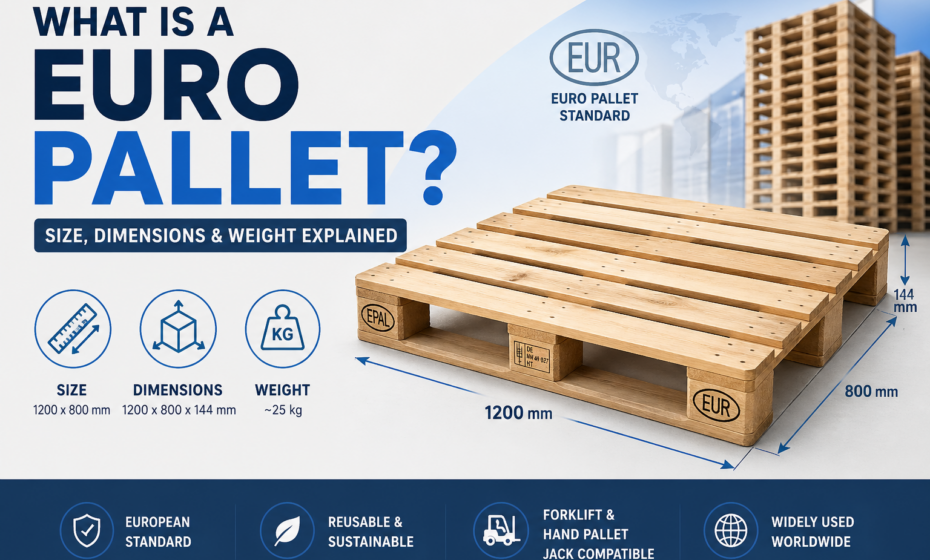
These three terms — Euro pallet, EPAL pallet, and EUR pallet — are widely used across European logistics, and they usually refer to the same physical platform: an 800 × 1200 mm wooden pallet.
A Euro pallet is the general term for the standard 1,200 × 800 mm platform. It sets the size but doesn’t guarantee how it was built or whether it has certification. An EUR pallet has historical roots in European railways (UIC) and may still show the old stamp.
Nowadays, EUR and EPAL markings are mostly treated as interchangeable in logistics. However, the EUR stamp alone doesn’t provide the same quality control as a modern EPAL-certified pallet.
Note: An EPAL pallet is manufactured and certified under the strict quality standards of the European Pallet Association, founded in 1991 to manage quality and safety across the Euro pallet pool. EPAL pallets carry both the EPAL logo and the IPPC heat treatment stamp, produced exclusively by licensed manufacturers who undergo continual independent inspections. And only wood pallets can carry official EPAL certification.
American Pallets and European Pallet Association Standards
For businesses shipping between North America and Europe, understanding how the standard European pallet size compares to American pallets matters for container planning. The American pallet is larger, fitting wider North American containers. European pallets are narrower by design, engineered so that two pallets sit side by side in standard European trucks without wasting available space.
Euro Pallet Size and Dimensions
The Euro pallets size that defines European logistics is 800 mm x 1,200 mm x 144 mm (31.5 in x 47.2 in x 5.7 in). That 144 mm height accounts for the deck boards and nine wooden blocks that form the base, leaving clearance for forklifts to enter from all four sides.
Standard Euro Pallet Dimensions
The European pallet size did not become standard by accident. The 800 x 1,200 mm footprint was engineered so that two pallets fit precisely side by side in standard European trucks, making full use of trailer width. Standard articulated lorries can carry up to 33 Euro pallets, and a 40-foot trailer accommodates 30 to 34. Euro pallets are manufactured according to the UIC 435-2 standard, which establishes the technical and dimensional requirements for these pallets, ensuring compatibility and safety in logistics operations.
The table below covers the full range of approved Euro pallet types.
| EUR-PALLET TYPE | DIMENSION (W x L)CENTIMETERS | DIMENSION (W x L)MILLIMETERS | DIMENSION (W x L) INCHES | ISO PALLET ALTERNATIVE |
| EUR, EUR 1 | 80 x 120 | 800 x 1200 | 31.50 x 47.24 | ISO1, same size as EUR |
| EUR 2 | 120 x 100 | 1200 x 1,000 | 47.24 x 39.37 | ISO 2 |
| EUR 3 | 100 x 120 | 1000 x 1,200 | 39.37 x 47.24 | NA |
| EUR 6 (half pallet) | 80 x 60 | 800 x 600 | 31.50 x 23.62 | ISO0, half the size of EUR |
| 1/4 EUR pallet | 60 x 40 | 600 x 400 | 23.62 x 15.75 | quarter the size of EUR |
| 1/8 EUR pallet | 40 x 30 | 400 x 300 | 15.75 x 11.81 | one-eighth the size of EUR |
Euro Pallet Weight and Load Capacity
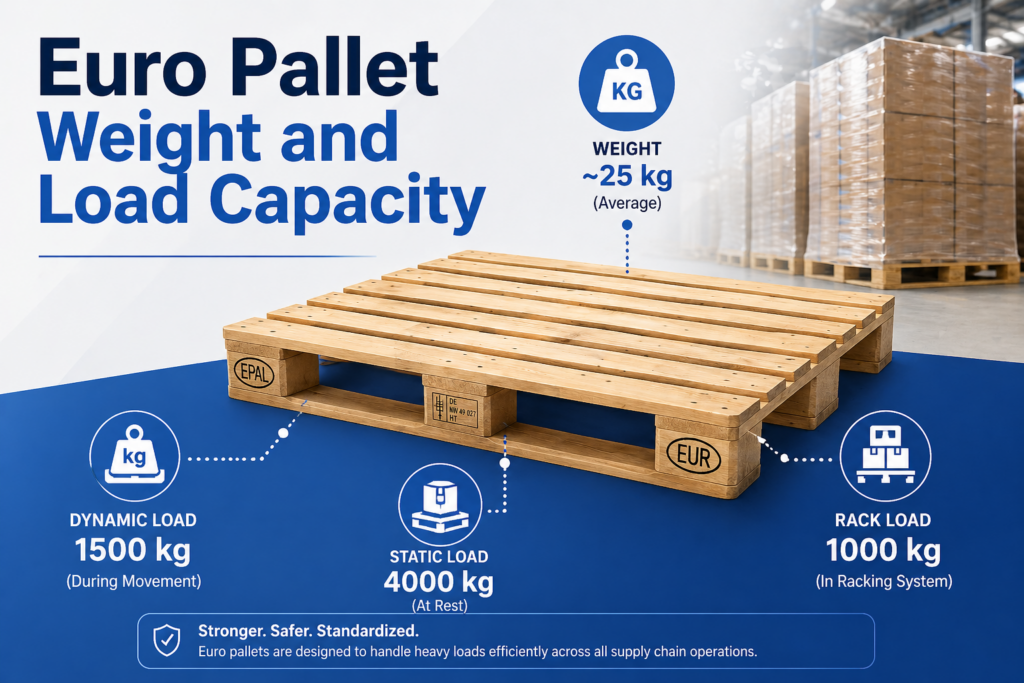
The size of Euro pallets tells part of the story. Load capacity tells the rest. An empty Euro pallet weighs approximately 25 kg. In operation, it supports a dynamic load of up to 1,500 kg during transportation, a static load of up to 4,000 kg when stored flat, and a racking load of up to 1,500 kg on used pallet racking systems. The usable surface area is 0.96 m².
These load ratings aren’t suggestions. They’re the specifications EPAL certification enforces, and exceeding them creates real risk of structural failure and workplace injury. According to EPAL’s published data, there are approximately 670 million EPAL Euro pallets in circulation globally, making the EPAL exchange pool the largest open pallet pool in the world.
Materials Used in Euro Pallets
The most common material for Euro pallets is pine, spruce, or poplar wood. They provide a good balance of strength, weight, and cost. Euro pallets must be constructed from dry wood to minimize the risk of mold, and they are treated to meet ISPM-15 standards for international shipping.
In addition to wood, Euro pallets can also be made from plastic and steel. But, only wooden pallets can carry the official EPAL certification, which ensures quality and safety standards. Plastic pallets resist moisture, don’t splinter, and work well in food processing or pharmaceutical settings. Plastic pallet bins offer similar benefits but are built for enclosed bulk storage, keeping goods secure and easy to handle.
Steel pallets are designed for the heaviest industrial loads or situations where chemical resistance is critical.
Euro Pallet Manufacturing Standards and Certification
All EPAL-certified Euro pallets must meet standards covering nail type, block dimensions, board thickness, and wood quality. EPAL awards licenses only to producers who pass independent inspections by organizations such as Bureau Veritas and Timber Products Inspection. Every certified pallet carries the EPAL logo on the left block, the EUR logo on the right block, and the ISPM 15 treatment stamp on the center block.
Heat Treatment and ISPM 15 Compliance
All Euro pallets must comply with the International Standard for Phytosanitary Measures ISPM-15. It requires heat treatment of wood to prevent the spread of pests in international trade. According to the USDA Animal and Plant Health Inspection Service (APHIS), all wood packaging material entering or leaving the United States must be treated and certified to this standard. Heat treatment requires the wood core to reach 56°C for at least 30 minutes.
Advantages of Using Euro Pallets in Logistics
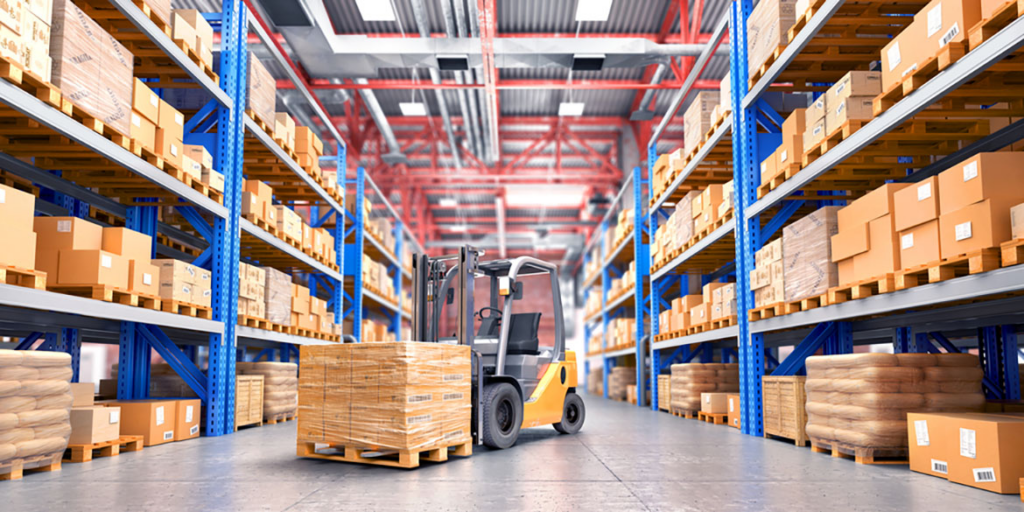
Euro pallets make moving, storing, and shipping goods easier and more reliable. Their uniform size and EPAL certification mean forklifts, racking systems, and trucks work with them without adjustments, which keeps operations smooth and predictable.
Standardization, Cost Reduction, and Automation Compatibility
The main advantage of Euro pallets in modern logistics is their consistent size. All EPAL-certified pallets are produced with the same standard dimensions of 800 x 1,200 mm, enabling easy handling for forklifts, racking systems, and trucks with no modification. This consistency cuts the requirement for tailor-made equipment or manual handling, thus minimizing operational costs.
Standard dimensions also make Euro pallets ideal for automated systems like conveyors and robotic pickers, improving warehouse speed and reliability while minimizing errors.
Reusability, Safety, and Warehouse Efficiency
Euro pallets are a key tool in Europe’s circular economy. EPAL’s exchange pool has operated on the principle of reuse, repair, and recycling for over three decades. The four-way entry design allows forklifts to approach from any side, speeding up warehouse operations and reducing manual handling that leads to workplace injury. Greater stability under load compared to lighter American pallet designs also reduces product damage in transit.
Why Euro Pallet Size Matters in Global Logistics
Container optimization, truck loading, and warehouse storage systems all depend on the 800 x 1,200 mm standard holding firm. Two Euro pallets placed side by side fit precisely in standard European trucks, leaving no wasted space. That design efficiency reduces transportation costs per unit and improves the efficient use of trailer volume.
The standard footprint means off-the-shelf racking systems accept Euro pallets without custom modifications. In international markets, alignment with ISO pallet standards extends Euro pallet compatibility into global trade lanes well beyond Europe.
Euro Pallets: The Backbone of Modern Supply Chains
Euro pallets simplify moving, storing, and shipping goods. Their consistent size and sturdy construction fit standard racks, trucks, and automated systems, reducing handling errors and saving time. For those looking to optimize logistics, using pallets that meet EPAL standards ensures reliability and efficiency across the supply chain.
Container Exchanger has a wide variety of Euro pallets available including new and used pallets made from wooden, plastic and steel. We sell a variety of bulk containers, storage totes, wire baskets, plus more. Companies can find the right solution for their storage and shipping needs while taking advantage of these operational benefits. View our inventory today, and reach out with any questions on what different containers can do for your supply chain business.