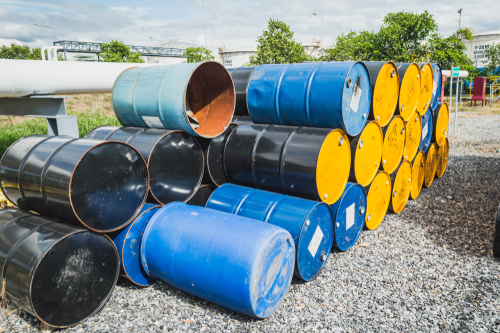
If you’re sizing a drum for a pallet, a truck, a doorway, or a storage rack, you need exact numbers, not a photo. Below are the height, diameter, and empty-weight specs for steel, poly, and fiber 55-gallon drums, plus how they stack up against 30-gallon drums.
Quick Answer: How Tall Is a 55-Gallon Drum?
A standard 55-gallon drum is commonly 34.5–37 inches tall and 22.5–23.5 inches in diameter, depending on material:
| Steel (closed-head) | ~34.5–35 in tall | ~22.5 in diameter | ~38–48 lbs empty |
| Poly (HDPE) | ~35–37 in tall | ~22.5–23.5 in diameter | ~20–25 lbs empty |
| Fiber | ~34–35.5 in tall | ~19–21 in diameter | ~12–18 lbs empty |
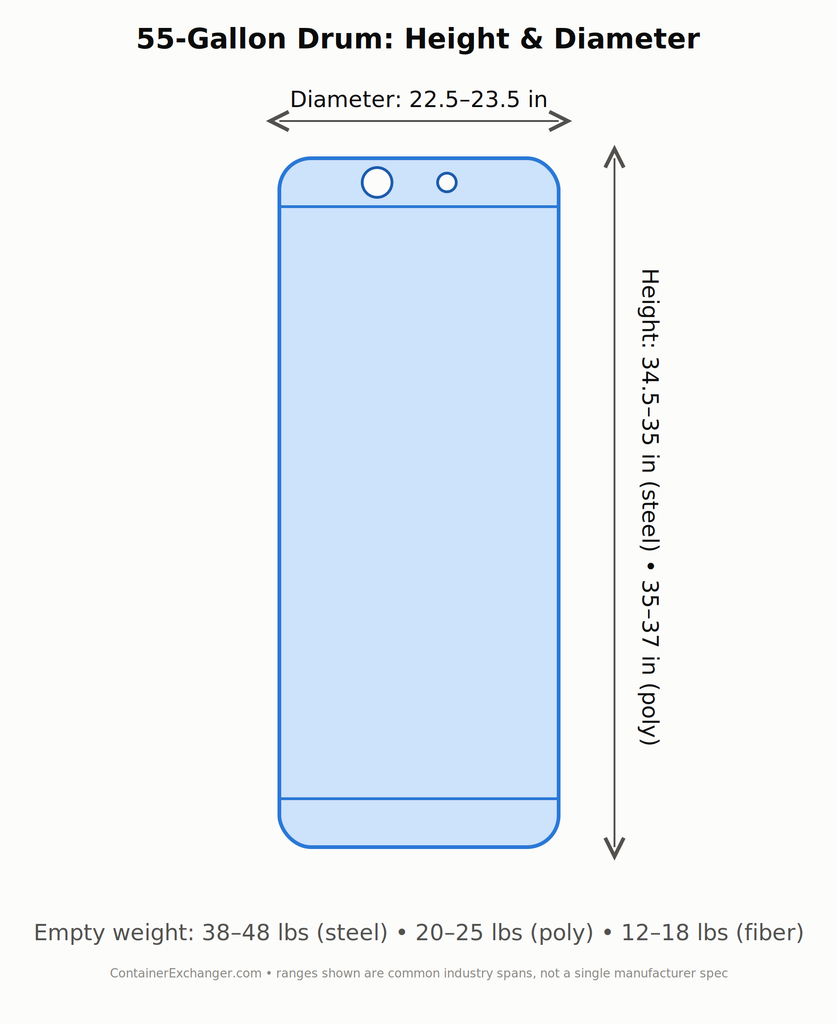
Poly drums generally run 1–2 inches taller than steel drums of the same 55-gallon capacity because HDPE walls are molded thicker and the domed top/bottom adds height that steel’s flat-formed heads don’t. Always confirm the spec sheet for the specific drum you’re buying — chime style, head type, and manufacturer tooling all shift these numbers slightly.
Steel vs. Poly vs. Fiber: 55-Gallon Drum Dimensions Compared
Use this table to match drum material to your load, chemical compatibility, and handling equipment.
| Material | Height (in) | Outside Diameter (in) | Empty Weight (lbs) | Wall/Construction |
| Steel (tight/closed-head) | 34.5–35 | 22.5–23 | 38–48 | 18–20 gauge steel, welded seam |
| Steel (open-head) | 34.5–35 | 22.5–23 | 40-50 | 18–20 gauge steel + removable ring-lock lid |
| Poly / HDPE | 35–37 | 22.5–23.5 | 20-25 | High-density polyethylene, ~3/16 in wall |
| Fiber | 34–35.5 | 19–21 | 12-18 | Spiral-wound fiberboard, single or double wall |
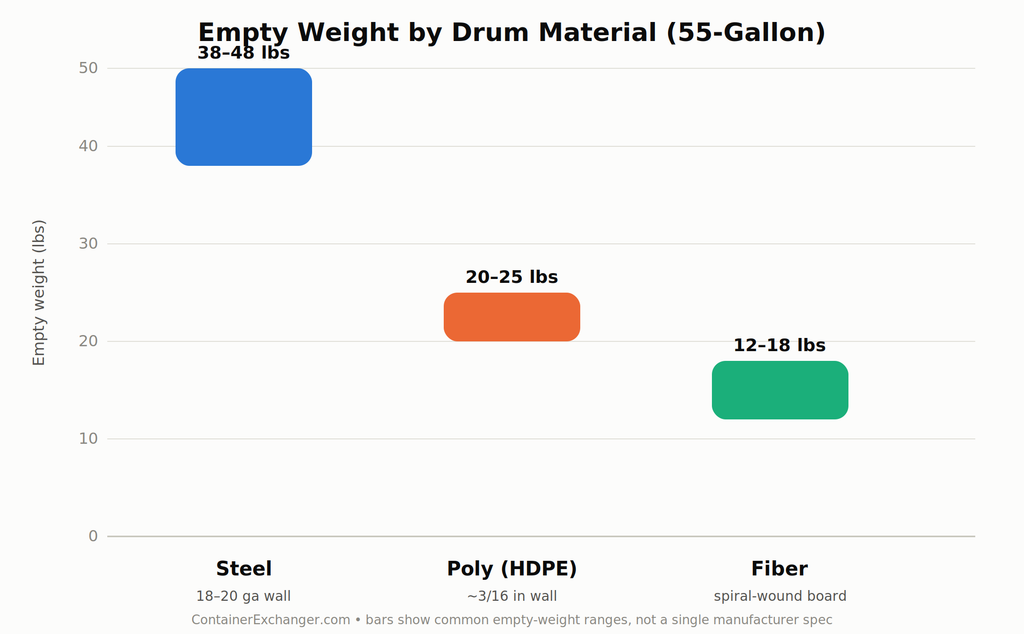
Reading the table for your use case:
- Steel holds up best for flammables, solvents, and high-heat contents, and for repeated reuse under rough handling — it’s also the heaviest, which matters for freight class and manual lifting.
- Poly is the lightest-to-handle option that still meets UN performance packaging ratings for many liquids, and it won’t rust or react with acids/caustics the way bare steel can.
- Fiber is the lightest overall and the narrowest, which is why it’s common for dry goods, powders, and single-trip shipping rather than liquids — it’s not a reusable, washable container the way steel and poly are.
Note that “55-gallon” is a nominal capacity, not a guaranteed brim-full volume. Manufacturing tolerances and headspace mean the true fill capacity of a given drum can run a percent or two off the nominal number — plan pallet and freight loads around the outside dimensions above, not the gallon label alone.
30-Gallon vs. 55-Gallon Drum: Size Comparison
Stepping down a size class changes more than capacity — it changes footprint, empty weight, and how many fit on a standard 40×48 pallet.
| Spec | 30-Gallon Drum | 55-Gallon Drum |
| Height (in) | 28–29.5 | 34.5–37 |
| Outside diameter (in) | 18–19 | 22.5–23.5 |
| Empty weight — steel (lbs) | 24–30 | 38–48 |
| Empty weight — poly (lbs) | 14–18 | 20–25 |
| Capacity vs. 55-gal | ~55% of the volume | full 55-gal reference |
| Typical pallet count (40×48) | 6 drums | 4 drums |
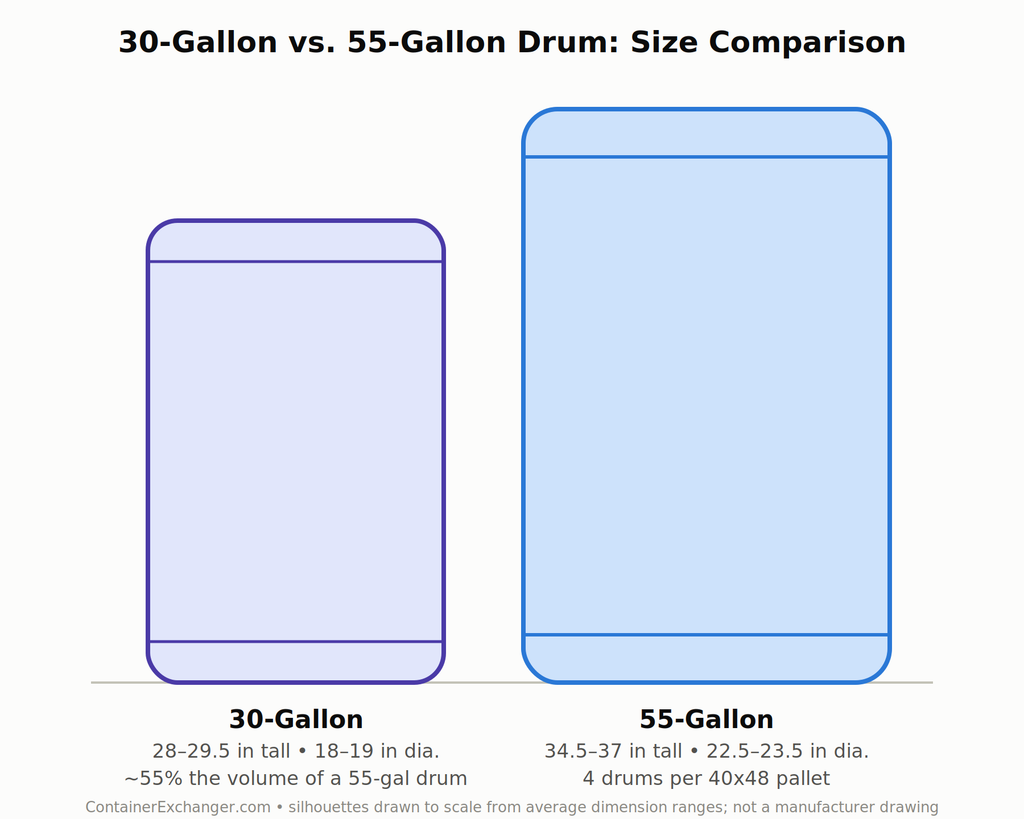
When to drop to a 30-gallon drum: tighter storage footprint, lower per-unit weight for manual handling (no lift assist), narrower doorways or aisles, or a batch size that doesn’t justify a full 55-gallon fill. When to stay at 55-gallon: you’re optimizing cost-per-gallon on freight and storage — the 55-gallon size is almost always the lower cost per gallon of capacity because fixed packaging and handling costs spread across more volume.
Open-Head vs. Closed-Head Drums
Dimensions are only part of the spec — head type determines how you get product in and out.
- Closed-head (tight-head) drums have a fixed top with two bungs (typically 2 in and 3/4 in) for pumping or pouring liquids in and out. They’re the standard choice for free-flowing liquids, solvents, and anything you’ll dispense with a pump or spigot. Height and diameter match the steel/poly rows above.
- Open-head drums have a fully removable lid secured by a bolt ring or lever-lock ring, giving full-diameter access to the interior. They’re the right choice for viscous products, solids, parts washing, or anything you need to scoop, pour in bulk, or inspect visually. Open-head drums run marginally heavier than closed-head drums of the same material because of the ring and lid hardware, but outside height and diameter are essentially the same.
If you’re not sure which head type you need: if a pump or hose reaches the product, go closed-head; if a hand, shovel, or scoop reaches the product, go open-head.
Food-Grade Drum Note
Steel, poly, and fiber 55-gallon drums are all available in food-grade construction, but “food-grade” is a materials and prior-contents standard, not a dimension — a food-grade poly drum has the same height/diameter/weight specs as a standard poly drum above. What changes is the resin (virgin HDPE) and prior-use history required for FDA/USDA-compliant handling. For the full requirements on what qualifies a drum as food-grade, see our guide on what you need to know about food-grade barrels.
FAQ: 55-Gallon Drum Dimensions
How tall is a 55-gallon drum?
Commonly 34.5–35 inches for steel and 35–37 inches for poly, measured to the top of the chime. Always check the manufacturer spec sheet for bung or lid hardware that adds to overall height.
What is the diameter of a 55-gallon drum?
Commonly 22.5–23.5 inches outside diameter across steel and poly. Fiber drums run narrower, commonly 19–21 inches.
How much does an empty 55-gallon drum weigh?
Steel drums commonly weigh 38–48 lbs empty; poly drums commonly weigh 20–25 lbs empty; fiber drums commonly weigh 12–18 lbs empty. Gauge/wall thickness and head type (open vs. closed) shift these numbers.
Will a 55-gallon drum fit through a standard doorway?
Yes. A standard interior doorway (30–36 in clear width) comfortably clears a 55-gallon drum’s ~22.5–23.5 in diameter, but leave margin for a hand truck or drum dolly if you’re moving a full drum rather than rolling it on its chime.
How many 55-gallon drums fit on a standard pallet?
Four 55-gallon drums is the typical count on a standard 40×48 in pallet, arranged in a 2×2 footprint. 30-gallon drums typically fit six to a pallet given their smaller diameter.
Is a 55-gallon drum the same size across steel, poly, and fiber?
No. Capacity is standardized at 55 gallons, but outside height and diameter vary by material and manufacturer, as shown in the comparison table above. Confirm exact dimensions before you finalize rack, pallet, or trailer layouts.
Shop Used 55-Gallon Drums
Need drums that already match these specs? Browse used 55-gallon drums for sale, or see the full range of storage drums in bulk across steel, poly, and fiber. Reconditioned and used drums carry the same outside dimensions as new stock, at a lower cost per unit — ask about volume pricing for pallet and truckload orders.