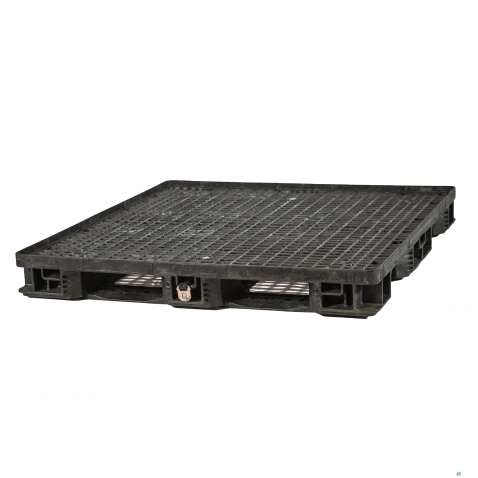
Plastic pallets are a durable, reusable alternative to wood that can improve hygiene, consistency, and lifecycle cost across your supply chain. This guide walks through common pallet types, materials, standard sizes, load capacities, and key tips for choosing the right pallet for your operation.
Types of Plastic Pallets
There are several main types of plastic pallets, each optimized for different handling and storage methods. Two-way entry pallets only allow forks in from two sides, while four-way entry pallets work from all directions. Most plastic pallets today feature four-way access, which makes trailer loading and warehouse handling much more flexible.
Stackable pallets are designed to sit securely on top of one another when loaded. Rackable pallets are strong enough to hold weight in pallet racking systems without bowing or failing. Nestable pallets have legs that fit into one another when empty, reducing empty pallet storage space by up to 75 percent.
What Are Plastic Pallets Made Of?
Material choice has a big impact on performance and recyclability.
Plastics are often grouped into thermosets and thermoplastics. Thermosets harden permanently and are very difficult to recycle. Thermoplastics can be melted and reformed, which makes true cradle-to-cradle recycling possible at the end of life.
Polyethylene (PE) is the most widely used plastic globally and is common in pallet manufacturing. It stays stable across a wide temperature range and handles impacts well.
High-density polyethylene (HDPE) is the preferred grade for many high-quality pallets because it combines strength, stiffness, and recyclability. PVC is dense and hard but can turn brittle at low temperatures, which limits its use.
ABS offers good strength for its weight, but it can be more sensitive to light unless properly stabilized, so it tends to be used in more specific applications.
Other Pallet Types: Wood, Metal, and More
Plastic pallets compete most directly with wood pallets and, in some heavy-duty cases, metal pallets.
Wood pallets are still widely used and relatively inexpensive up front, but they often last only two to three years in real-world operations and require ISPM-15 heat treatment for international export. That adds cost and extra compliance steps.
Metal pallets are used in heavy-duty applications where very high load capacities, fire resistance, or extreme durability are required. They’re much heavier and more expensive than plastic.
Compared to both, plastic pallets offer a middle ground: longer life than wood, lighter weight than metal, and no ISPM-15 requirement.
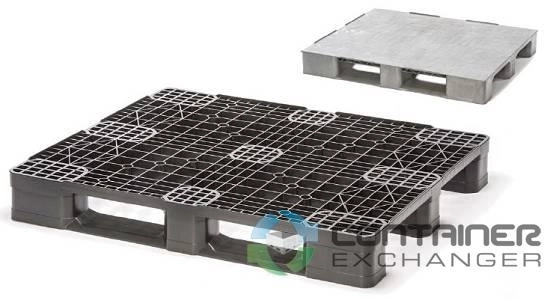
Most plastic pallets’ size ranges follow existing infrastructure. Regional standards grew out of truck, rail, warehouse, and container dimensions, and the International Organization for Standardization (ISO) now recognizes specific footprints for global trade, so the same core sizes repeat across many industries and regions.
U.S. and North American Standard Plastic Pallet Sizes
In North America, the 48 × 40-inch pallet is the dominant standard for general shipping and warehousing. It’s often called the GMA pallet and shows up across grocery, retail, and manufacturing. Some specifications list it as 40 × 48, but the footprint is the same, just reversed.
Here are the most common North American plastic pallet sizes and use cases.
| Size (inches) | Common Use / Notes |
| 48 × 40 | GMA / North American standard for general shipping and supply chains |
| 48 × 45 | North American automotive pallet industry standard footprint |
| 48 × 48 | Chemical industry; designed to hold four 55-gallon drums without overhang |
| 45 × 45 | Comparable to chemical industry CP9 standard (1140 × 1140 mm) |
| 43 × 43 | Designed to fit Bulk super bags; matches 1100 × 1100 mm Asian standard and is ISO-approved |
Height varies slightly based on deck and runner design, but most plastic pallets in these sizes are roughly 5 to 6 inches tall.
More Plastic Pallet Sizes: International and Euro Pallets
Outside North America, different footprints dominate, especially in Europe and Asia. ISO recognizes several of these sizes, and they’re now common in plastic pallet lines worldwide.
| Size (mm) | Name / Region / Use |
| 800 × 1200 | ISO1 / EUR pallet; European Pallet Association standard, fits most doorways, widely used for import/export |
| 1000 × 1200 | ISO2; common across Europe and Asia |
| 1067 × 1067 | Used in Europe, North America, and Asia for mixed global flows |
| 1219 × 1016 | North American metric equivalent of 48 × 40 inches |
| 1165 × 1165 | Australian standard; designed around railway container compatibility |
| 1100 × 1100 | Asian standard (Japan, Korea, China); square, often reversible |
| 1200 × 1200 | Popular for large bags, bulk drums, and high-volume storage |
| 1140 × 1140 | Widely used in the chemical industry and optimized for shipping container loading |
The Euro 800 × 1200 mm pallet is the workhorse in Europe and is the second most popular plastic pallet size globally. Sizes like 1100 × 1100 mm and 1140 × 1140 mm are especially important if you’re shipping into or out of Asia or serving chemical supply chains that cube out ocean containers.
Quarter and Half Pallets
Full-size pallets aren’t always the most efficient choice, especially in retail and display-heavy environments, so half- and quarter-pallets fill that gap.
Half pallets are commonly used as retail-ready bases for product displays in narrow or crowded aisles. Two important fractional sizes are 40 × 24 inches (1000 × 600 mm), which is common in Europe, and 48 × 20 inches (1200 × 500 mm), a standard North American fractional size.
Quarter pallets are even smaller and are mainly used for promotions and point-of-sale displays. Typical quarter pallet sizes include 24 × 20 inches (600 × 500 mm) and 24 × 24 inches (600 × 600 mm). These small footprints let brands roll prebuilt displays straight onto the floor with minimal handling.
Understanding Plastic Pallet Load Capacities
Pallet size is only useful if it matches the weight and handling demands of your operation. Plastic pallet bins and other heavy-duty bulk containers can concentrate a lot of weight in a small area, so it’s critical to get the numbers right. Manufacturers typically publish three load ratings for each pallet: static, dynamic, and racking.
Static Load Capacity
Static load capacity is the maximum weight a pallet can support when it’s stationary on a level surface. This covers scenarios such as pallets stacked on the warehouse floor or long-term storage, where loads aren’t being moved.
Static ratings on high-quality rackable pallets can reach 30,000 pounds or more. It’s also common to see static capacities above 17,600 pounds for many robust plastic designs, which exceed those of many wooden pallets. If you stack loaded pallets or store heavy bulk products for long periods, the static rating is the first number to confirm.
Dynamic Load Capacity
Dynamic load capacity describes how much weight a pallet can safely carry while being moved. This includes forklift travel, pallet jack movement, and conveyor handling. Because motion introduces vibration and impact, dynamic ratings are lower than static ratings for the same pallet.
Dynamic capacity is often the most relevant number. If your team routinely moves heavy loads, picking a pallet with an inadequate dynamic load rating is one of the most common and costly mistakes. It can lead to gradual flexing, cracking, or sudden failure, especially at dock plates or on uneven floors.
Racking Load Capacity
Racking load capacity is the most demanding scenario for a pallet. It describes how much weight the pallet can hold when it’s supported only at its edges or on rack beams, with open space underneath. This puts the deck under bending stress that you won’t see on the floor.
Not every pallet is rackable. Many nestable pallets and lighter export designs are meant only for floor storage or block stacking. Using them in selective or drive-in racks is a serious risk. For warehouse buyers, it’s critical to confirm whether a pallet is rated for racking and to match that rating to your rack system’s beam spacing and support style. If your operation depends heavily on racking, this should be a primary selection filter.
Benefits of Plastic Pallets Over Other Materials
Plastic pallets come with a higher upfront cost than wood pallets, but the long-term view tells a different story. Many plastic pallets last 10 to 15 years in normal use, compared with two to three years for typical wood pallets. When you calculate the total cost of business, the difference in lifespan, repair needs, and product damage can quickly shift the math.
Plastic pallets are also exempt from ISPM-15 heat treatment regulations, which simplifies exports and reduces the risk of shipment delays due to pallet compliance issues. For food, beverage, and pharmaceutical supply chains, the non-porous plastic surface is easier to clean and sanitize, supporting FDA and FSMA requirements.
Another advantage is traceability. Many plastic pallets can be molded with provisions for RFID tags, which enables real-time tracking that most pallet blogs never touch. Add in a lower weight than many wood or metal pallets, plus fewer splinters, nails, and breakages, and you get safer handling and lower transport costs over time.
How to Choose the Right Plastic Pallet
The right pallet is a fit between your product, equipment, and regulatory landscape. A plastic pallet’s size should match your load footprint and weight. Oversized pallets waste space; undersized pallets cause overhang, instability, and damage. If you’re using any kind of bulk container or heavy-duty bin, make sure its base matches the pallet footprint and load rating.
Storage and handling conditions come next. Your pallet has to work inside the rack system, on conveyors, and with forklifts and pallet jacks. Racking type, aisle widths, and container door sizes all matter.
Industry standards layer on top. Food and pharma operations care about FDA and FSMA compliance, chemical supply chains may align with Cleaner Production standards, and automotive often expects 48 × 45 pallets. In general, choosing a standard-sized pallet simplifies logistics at every handoff. When you weigh upfront spend against long-term, remember to factor in lifespan, worker safety, damage rates, and any need for bulk container compatibility.
FAQs
What is the most common pallet size in the United States?
The most common pallet size in the United States is 48 × 40 inches. It’s used across grocery, retail, and manufacturing and is the default size for most racking, trailers, and material-handling equipment.
Can the wrong pallet size impact warehouse operations?
Yes. A pallet that doesn’t match your rack dimensions, forklift patterns, or trailer layout can reduce storage density, create awkward overhang, and slow down picking.
Where is the best place to buy plastic pallets?
The best place to buy plastic pallets depends on your volume and whether you need new or used units. For most buyers, a specialist marketplace like Container Exchanger is ideal, because you can compare new and used plastic pallets side by side and match standard sizes to your budget and application.
What is the difference between nestable and rackable pallets?
Nestable pallets are designed so that their feet fit inside one another, dramatically reducing the space required for empty pallets. They’re ideal for export and one-way shipping. Rackable pallets are built with a reinforced deck and runners to support weight in pallet racks. They take up more space when empty, but are essential in rack-heavy warehouses.
What is the height of a standard pallet?
A typical 48 × 40-inch pallet is roughly 5-6 inches tall, depending on design. Many plastic pallets follow similar height ranges, though heavy-duty rackable models may be slightly taller.
Can I use plastic pallets for export?
Yes. Plastic pallets are well-suited for export because they’re exempt from ISPM-15 requirements that apply to wood. That means fewer regulatory steps and a lower risk of border delays due to pallet documentation or treatment issues.
Find Your Perfect Fit: Shop Plastic Pallets at Container Exchanger
Standard pallet sizes, regional differences, and load ratings can feel like alphabet soup until you match them to real products and equipment.
When you’re ready to buy, Container Exchanger makes it easy to compare new plastic pallets and used pallets side by side so you can find the right fit for your budget, warehouse, and long-term supply chain strategy.