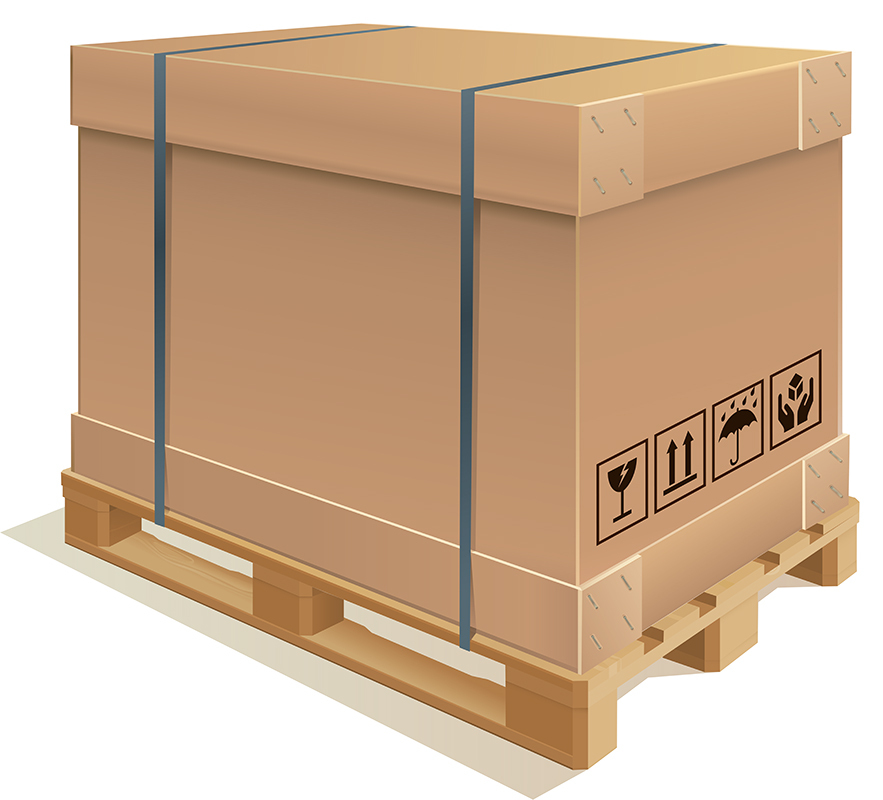
What Is a Gaylord Box?
A gaylord box is a large corrugated bulk container — typically built on a 48″ x 40″ footprint to match a standard pallet — used to ship, store, and handle loose or bulk material such as parts, scrap, produce, film, or resin. Gaylord boxes come in 2-wall, 3-wall, 4-wall, and 5-wall corrugated constructions, with wall count determining stacking strength and static load capacity. They’re sold both new and used, and used gaylords typically cost 40-70% less than new while still holding several hundred to several thousand pounds depending on wall count.
Gaylords are also called pallet boxes, bulk bins, or (in an octagonal shape) octabins. If you’ve searched “gaylord” or “gaylord box,” this guide covers the sizes, wall counts, and pricing you need to spec and buy the right one — new or used.
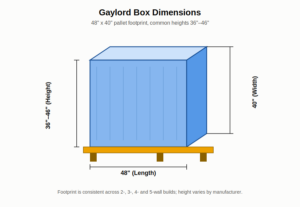
Gaylord Box Sizes by Wall Count
Nearly every gaylord box on the market shares the same 48″ x 40″ pallet-matched footprint. What changes by wall count is the corrugated thickness (and therefore the strength), the common height options, and the price. The table below uses the 48″ x 40″ footprint at commonly stocked heights; cubic footage is calculated directly from those dimensions (L x W x H ÷ 1,728).
| Wall Count | Typical Footprint | Common Height Range | Cubic Footage (at 36″–41″ height) | Commonly Cited Static Load Capacity |
|---|---|---|---|---|
| 2-Wall (Double Wall) | 48″ x 40″ | 30″–36″ | ~33.3–40.0 cu ft | commonly 800–1,200 lb |
| 3-Wall (Triple Wall) | 48″ x 40″ | 34″–40″ | ~37.8–44.4 cu ft | commonly 1,000–1,600 lb |
| 4-Wall | 48″ x 40″ | 36″–41″ | ~40.0–45.6 cu ft | commonly 1,500–2,200 lb |
| 5-Wall (Heavy Duty) | 48″ x 40″ | 36″–46″ | ~40.0–51.1 cu ft | commonly 2,000–3,000 lb |
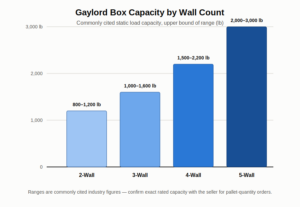
A few notes on reading this table:
- Wall count = layers of corrugated board, not overall box thickness alone. Each added wall increases edge crush test (ECT) rating and stacking strength, which is why 5-wall gaylords are rated for roughly double or more the load of a 2-wall box on the same footprint.
- Heights vary by manufacturer. Because gaylord boxes are typically die-cut and assembled from a bottom tray plus a sleeve, the same wall count can ship at several different heights. Treat the ranges above as commonly stocked, not universal — always confirm exact height and ECT rating with the seller before ordering pallet-quantity lots.
- Static load capacity is a commonly cited range, not a guarantee. Real-world capacity depends on fill material, humidity, stacking height, and how the load is distributed. Manufacturers publish their own tested capacities per SKU — use the table above to shortlist a wall count, then confirm the spec sheet.
Watermelon Bins & Octagon Gaylords
For produce — watermelons, cantaloupes, squash, and similar bulk fruit and vegetable loads — you’ll frequently see octagon gaylord boxes, sometimes called watermelon bins or octabins. These use the same 48″ x 40″ pallet footprint but an eight-sided (octagonal) wall layout instead of a rectangular one, which spreads stacking load more evenly around irregular, heavy produce and reduces corner blowouts. Octagon bins are almost always built in 5-wall or heavy-duty triple-wall construction because produce loads are heavy and the boxes are frequently reused across a harvest season before being recycled. If your search brought you here for “watermelon bin” or “octagon gaylord,” the sizing and wall-count logic above applies — just add the octagonal wall profile.
Gaylord Box Cost: New vs. Used, by Wall Count
This is the number most buyers actually want, and it’s also where the biggest savings sit. New gaylord boxes are priced primarily by wall count and ECT rating (strength), while used gaylords are priced by wall count and condition grade. Exact pricing varies by region, order volume, and current corrugated material costs, so treat the bands below as commonly cited ranges rather than a fixed price list — but they’re directionally consistent across the wholesale packaging market:
| Wall Count | Commonly Cited New Price (per box, single-unit) | Commonly Cited Used Price (per box, Grade A–B) | Typical Used Discount vs. New |
|---|---|---|---|
| 2-Wall | commonly $15–$25 | commonly $6–$12 | ~50-60% off |
| 3-Wall | commonly $22–$38 | commonly $9–$18 | ~50-55% off |
| 4-Wall | commonly $30–$50 | commonly $12–$24 | ~45-55% off |
| 5-Wall | commonly $40–$70+ | commonly $18–$35 | ~40-50% off |
Why the spread is so wide: new pricing is driven by ECT rating, print/branding, and current containerboard costs, while used pricing is driven by condition grade, how many prior use cycles the box has been through, and local supply (freight is a large share of gaylord cost, so regional availability matters as much as wall count). If you’re pricing “used gaylords” for a recurring shipping or storage program, buying by the pallet load rather than by the single unit is where most of the additional savings comes from — per-box pricing drops meaningfully at pallet and truckload quantities.
Bottom line: unless your load requires certified new strength ratings (food-grade, export, or first-use compliance requirements), a Grade A or B used gaylord in the correct wall count will hold the same load at close to half the cost.
Gaylord Box Condition Grades: A, B, C
Used gaylord boxes are graded so buyers can match condition to use case without paying new-box pricing for a box that’s only going to be used once or twice more. Grading isn’t fully standardized across every seller, but the market has converged on a familiar three-tier (occasionally four-tier) system:
- Grade A — Like-new / single-use. Used once or barely used, minimal creasing, no water damage, no structural repairs. Full strength rating intact. Priced closest to new.
- Grade B — Good, multi-use. Visible wear, minor creasing or scuffing, may have old labels or light staining, but no structural weakness. This is the workhorse grade for most internal shipping, storage, and bulk-material handling — the best value tier for most buyers.
- Grade C — Functional, cosmetic wear. Heavier creasing, some panel or corner repair (taped or reinforced), reduced remaining use cycles. Fine for one-way internal use, scrap collection, or non-stacked storage; not recommended for export or repeated top-loading.
Some sellers add a Grade D / recycle-only tier for boxes that are structurally compromised and priced for material recovery rather than reuse — worth asking about if you’re buying in bulk and want the lowest possible landed cost for a one-time internal use.
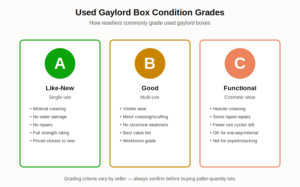
Always ask for the grading criteria and, on pallet-quantity orders, photos of a representative sample before you buy sight unseen.
Where to Buy and Sell Used Gaylord Boxes
Because gaylord boxes are heavy, freight cost is often the single biggest line item in total delivered price — buying from a regional or local seller usually beats a national new-box supplier on total cost once shipping is factored in. Container Exchanger’s gaylord box marketplace lists new and used gaylords by wall count, grade, and location so you can compare landed cost instead of just unit price.
If you’re on the other side of the transaction — a distribution center, manufacturer, or produce packer with a steady stream of used gaylords coming off pallets — those boxes have resale value instead of being a disposal cost. Selling your used gaylords through a marketplace instead of recycling them for scrap value typically recovers meaningfully more per box, especially at Grade A/B condition and in higher wall counts.
For exact dimension tolerances and a full breakdown of every standard gaylord footprint and height combination, see our companion gaylord box dimensions guide.
Shop used gaylord boxes by wall count, grade, and location, or list your used gaylords for sale and turn pallet-yard overflow into revenue instead of a disposal line item.
FAQ: Gaylord Boxes
What is a gaylord box used for?
Gaylord boxes are used to ship, store, and handle bulk or loose material — manufacturing scrap, plastic resin and regrind, textiles, produce, retail returns, and parts — anywhere a standard corrugated case is too small and a pallet-scale container is needed.
How much does a gaylord box cost?
New gaylord boxes commonly run $15–$70+ depending on wall count and ECT rating; used gaylords in Grade A–B condition commonly run $6–$35 depending on wall count, roughly 40-60% less than new. Buying by the pallet load lowers the per-box price further.
What size is a standard gaylord box?
Most gaylord boxes share a 48″ x 40″ footprint sized to a standard pallet, with heights commonly ranging from about 30″ to 46″ depending on wall count and manufacturer — see the size table above for cubic footage by height.
What’s the difference between a 2-wall and a 5-wall gaylord box?
Wall count is the number of corrugated layers in the box, which determines strength. A 2-wall (double wall) gaylord commonly holds a few hundred to about 1,200 lb, while a 5-wall (heavy duty) gaylord commonly holds up to 2,000–3,000 lb on the same footprint — roughly double to triple the capacity.
Are used gaylord boxes as strong as new ones?
A Grade A or B used gaylord in the correct wall count performs close to its original rated capacity. Strength drops in lower grades (C and below) due to creasing, moisture exposure, or prior repairs, so match the condition grade to how the box will be loaded and stacked.
What is an octagon gaylord or watermelon bin?
An octagon gaylord (also called a watermelon bin or octabin) is a bulk box with an eight-sided wall profile on the same 48″ x 40″ footprint, typically built in 5-wall or heavy triple-wall construction. It’s the standard choice for bulk produce because the octagonal shape distributes the load of heavy, irregular items more evenly than a rectangular box.
Can I buy or sell used gaylord boxes near me?
Yes — used gaylord availability and pricing are largely regional because freight is a major share of total cost. Search current used gaylord listings by location and wall count to compare local pricing before you buy or list boxes for sale.